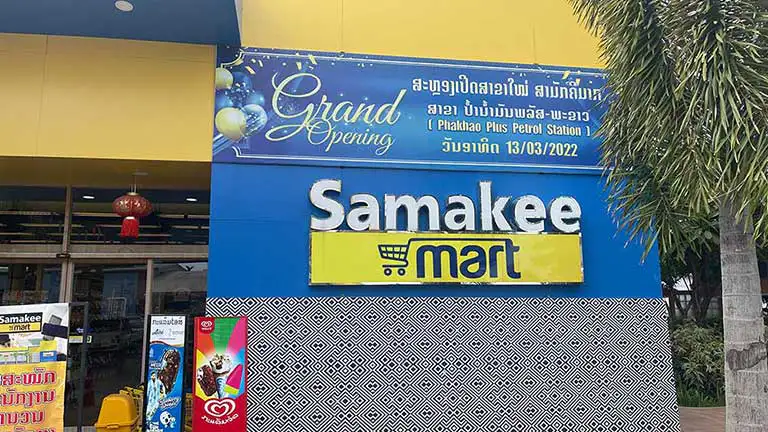
Samakee Mart: A New Wave of Local Retail
In Vientiane, the capital of Laos, the retail landscape is a fascinating blend. While traditional local markets still thrive, the city is increasingly dotted with modern supermarkets funded by Chinese, Malaysian, and Thai capital. Step inside one of these foreign-backed modern stores, and the familiar, sleek layouts make it almost impossible to guess which country you’re actually in.
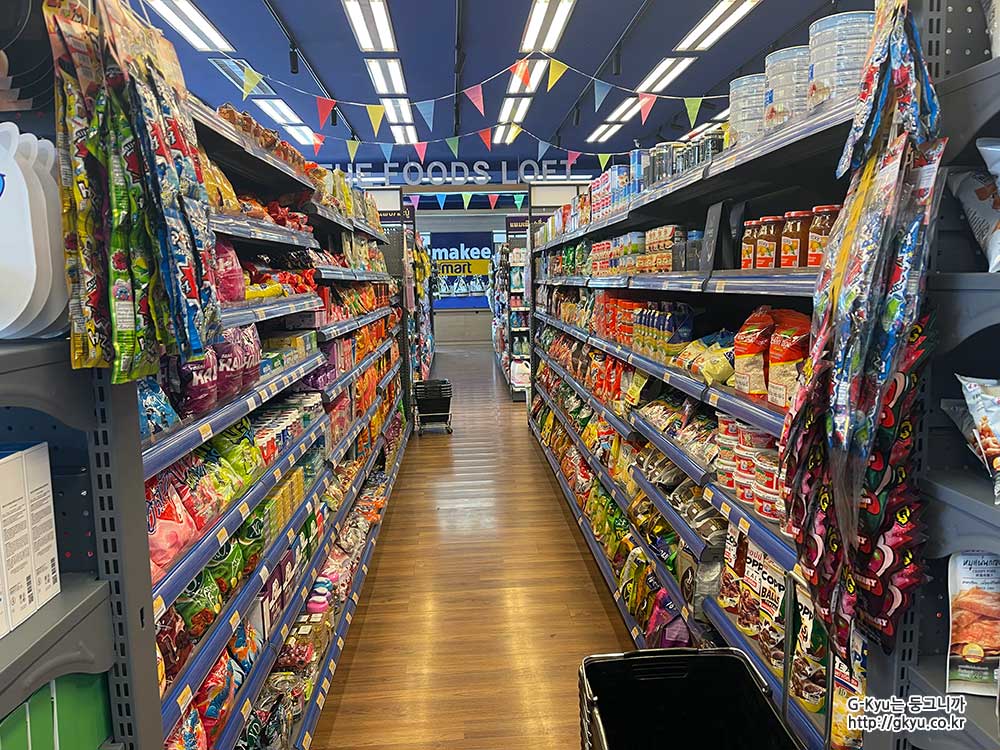
Yet, standing proudly among them is Samakee Mart. Run by one of Laos’s major conglomerates, this local supermarket easily rivals any foreign brand in terms of modernity and scale. Operating roughly on the concept of a large convenience store, it represents a significant leap forward for local retail.
The company has even developed its own proprietary payment application called the ‘Hi App.’ When visiting Samakee Mart, you can pay with either credit cards or cash, but those using the Hi App are treated to promotional gifts based on their purchase amount. While it might be rare for a short-term tourist to go through the hassle of downloading and registering for a local app, it’s clear that this is a game-changer for locals. With features like mobile ordering and tier-based rewards, the app is undoubtedly designed for high daily usage among Vientiane residents.
As of my visit in May 2023, there were three Samakee Marts operating in Vientiane. Ambitiously, they plan to open six more by the end of the year, bringing the total to nine. This gives locals and expats alike a pristine, air-conditioned alternative to the traditional wet markets. Furthermore, recognizing that tourists spend more time in nature-focused destinations like Vang Vieng and Luang Prabang rather than lingering in the capital, the company plans to expand to those regions as well.
If there is one crucial piece of information a traveler must know about Vientiane, it is that shops close remarkably early compared to South Korea. By 6:00 PM, most worthwhile stores have already locked their doors. Samakee Mart, however, stays open until 9:00 PM depending on the location, offering a rare and highly appreciated evening sanctuary for late shoppers.
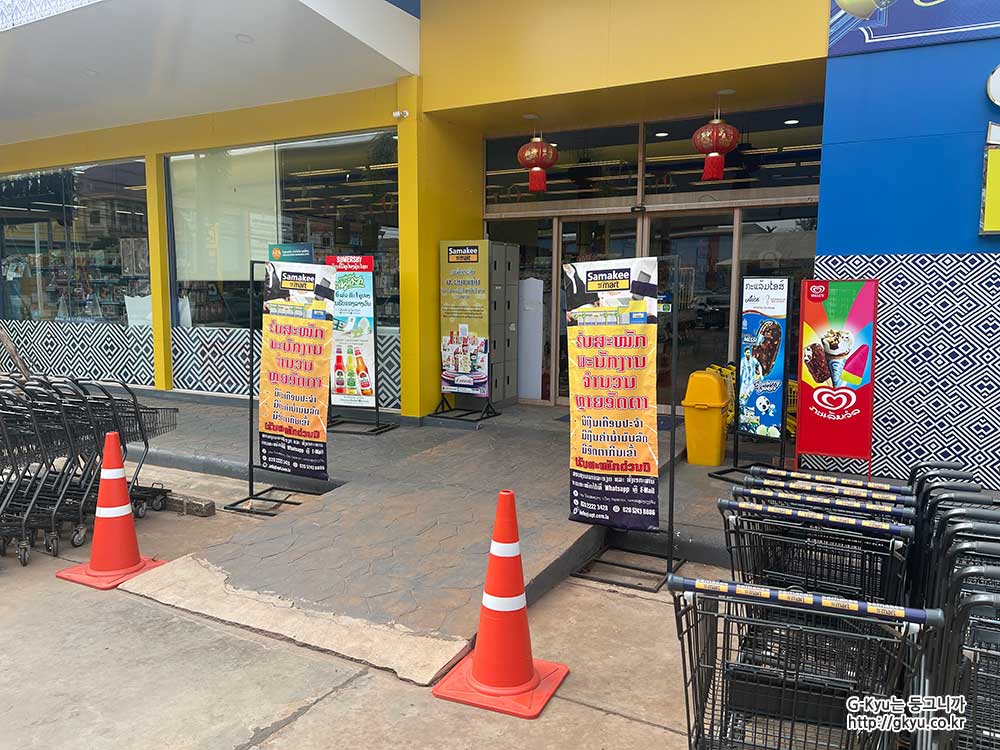
The name Samakee (ສາມັກຄີ) translates from Lao as “Solidarity” or “Unity.” It is a beautiful concept that can be interpreted in several ways. Perhaps it signifies consumers and sellers coming together in a win-win relationship, or maybe it reflects the seamless, “One-Stop” nature of the shopping experience where everything is united under one roof.
Another standout feature of Samakee Mart is its robust line of Private Brand (PB) products. I hadn’t noticed local PB goods during my visits to other major retailers like J-Mart, Rimping Mart, or the Parkson Department Store.
The Art of Souvenir Hunting in Laos
Laos is a beloved Southeast Asian destination for many Koreans, yet its specific tourist draws are not as universally documented as those of its neighbors. Countries like Thailand and Vietnam are flooded with travel guides detailing exactly where to go and what to buy. Laos, on the other hand, retains a sense of mystery; unless you actively seek out information, it’s hard to know what the country is truly famous for.
This inevitably leads to the traveler’s dilemma: What should I buy here? Purchasing standard manufactured goods feels lacking in local charm, and buying typical dried tropical fruits—a staple of any Southeast Asian trip—somehow feels a bit too cliché.
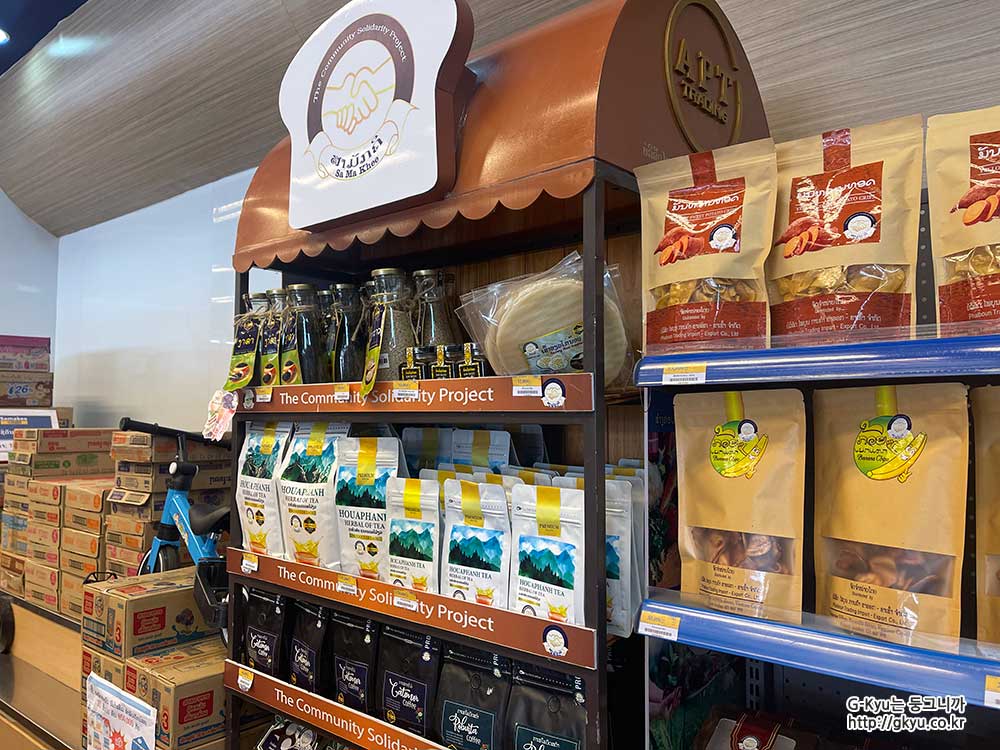
Laos is a landlocked, deeply mountainous country with significant high-altitude regions. Because of this geography, its true treasures lie in its primary agricultural industries: tropical fruits, high-altitude coffee, black tea, rice, and forest honey. This is where Samakee Mart’s PB products shine.
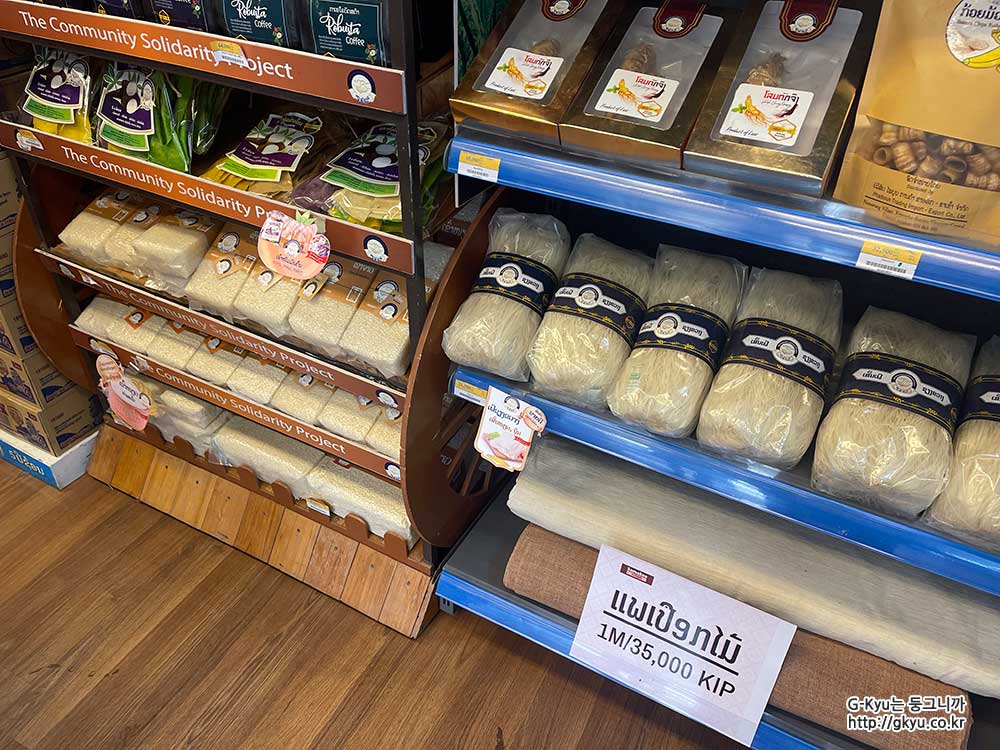
Operating with the backing of a large corporation, the mart collaborates directly with rural Laotian farming communities. They provide agricultural education, purchase the yields, and commercialize them into high-quality PB goods. Through continuous training, quality control, and refinement, they have produced an impressive array of local staples.
Scanning the shelves, I found an abundance of grains, coffee, tea, honey, and rice sourced from all over the country. On the bottom shelves, local rice was vacuum-sealed and sold in neat 5kg bags—a much more manageable size than the massive 10kg or 20kg sacks typically sold in Korea. Surprisingly, I even found Laotian ginseng among the PB offerings.
In Korea, buying regional specialties is a cultural norm because local produce is always fresher and of higher quality. Applying this logic to Laos, bringing home these seemingly ordinary but exceptionally high-quality local agricultural products makes for a wonderful, thoughtful gift.
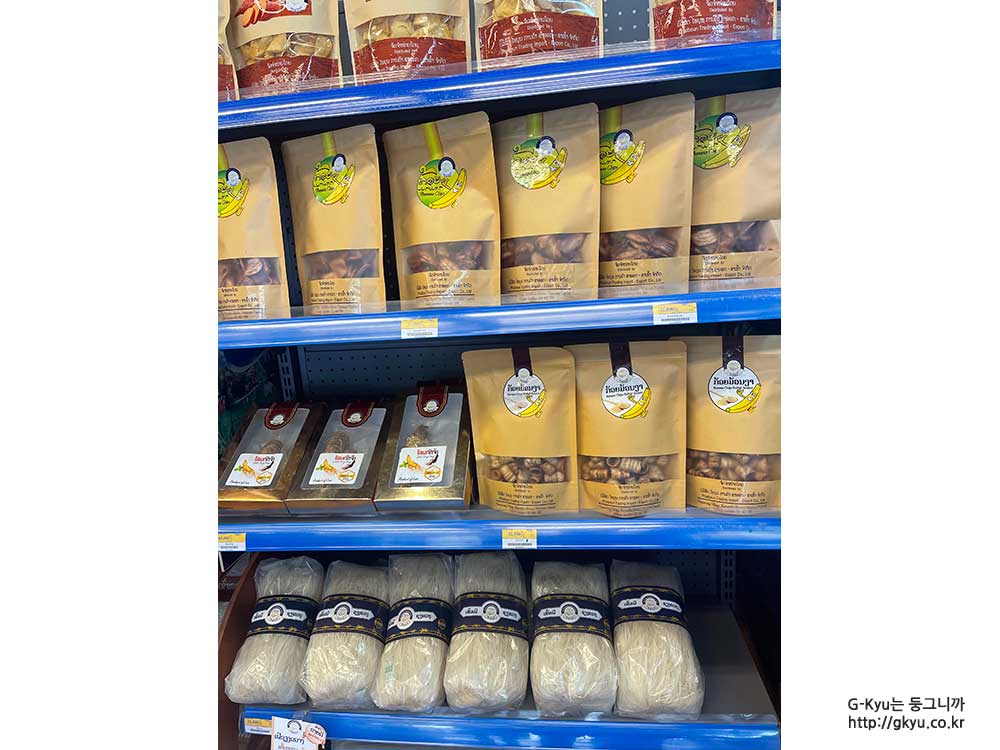
While buying a bag of rice seemed too heavy—and I worried it might not suit my taste back home—I remembered the delicious Laotian rice I had enjoyed at the Crowne Plaza Hotel and Kualao Restaurant (as detailed in Part 2). I didn’t buy the rice this time, but given its affordability, it is certainly worth a small purchase purely out of curiosity. I did, however, happily stock up on local honey, coffee, and tea, which I will review in a future post.
The K-Wave and Curious Counterfeits
Because Laos doesn’t have a massive manufacturing base, most processed foods and consumer goods are imported from neighboring countries. Despite sharing borders with Vietnam and Cambodia as well, the market is overwhelmingly dominated by Thai and Chinese products.
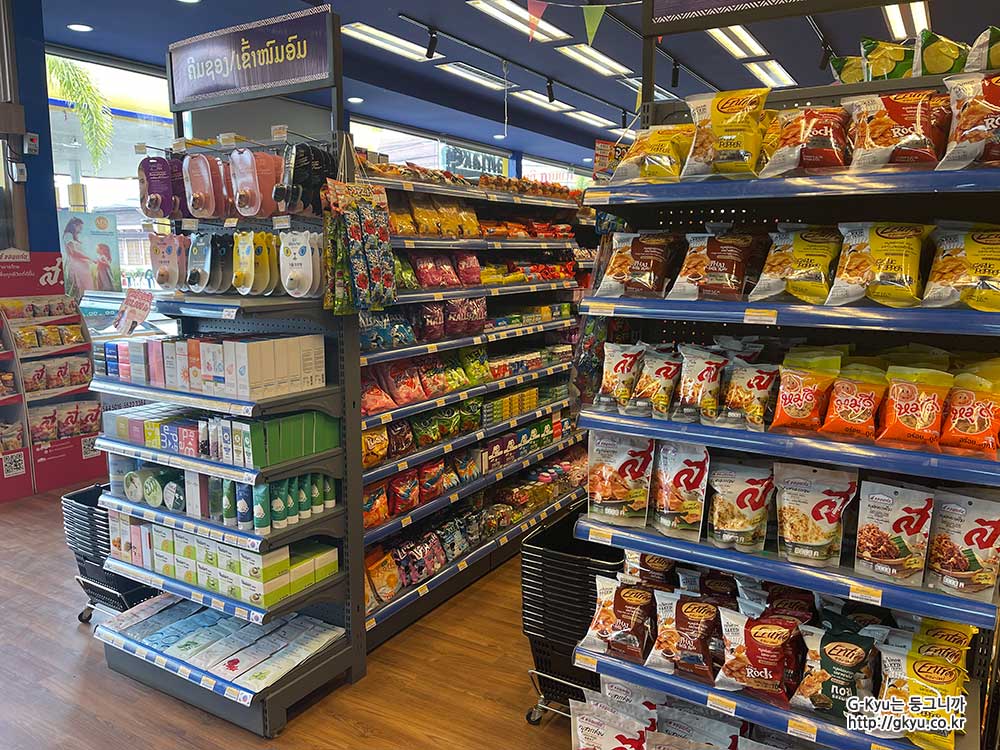
Yet, amidst this, Korean products occasionally make a proud appearance—particularly instant noodles and cosmetics. South Korean culture enjoys immense popularity in Laos. The locals are incredibly passionate about K-pop idols and actors, sometimes knowing more about them than Koreans do. I had heard rumors of the “Korean Wave” in Southeast Asia through the media, but witnessing the sheer scale of it in person was astonishing.
While there are countless idol groups, Blackpink holds a special place in the hearts of Laotians, with Lisa being the undisputed favorite. Her Thai heritage, combined with her massive success in a Korean girl group, clearly resonates deeply in this region. Even those who aren’t avid fans know exactly who Lisa is. It reminded me of how South Koreans universally support Tottenham Hotspur’s Son Heung-min in the English Premier League; it’s a profound sense of regional pride.
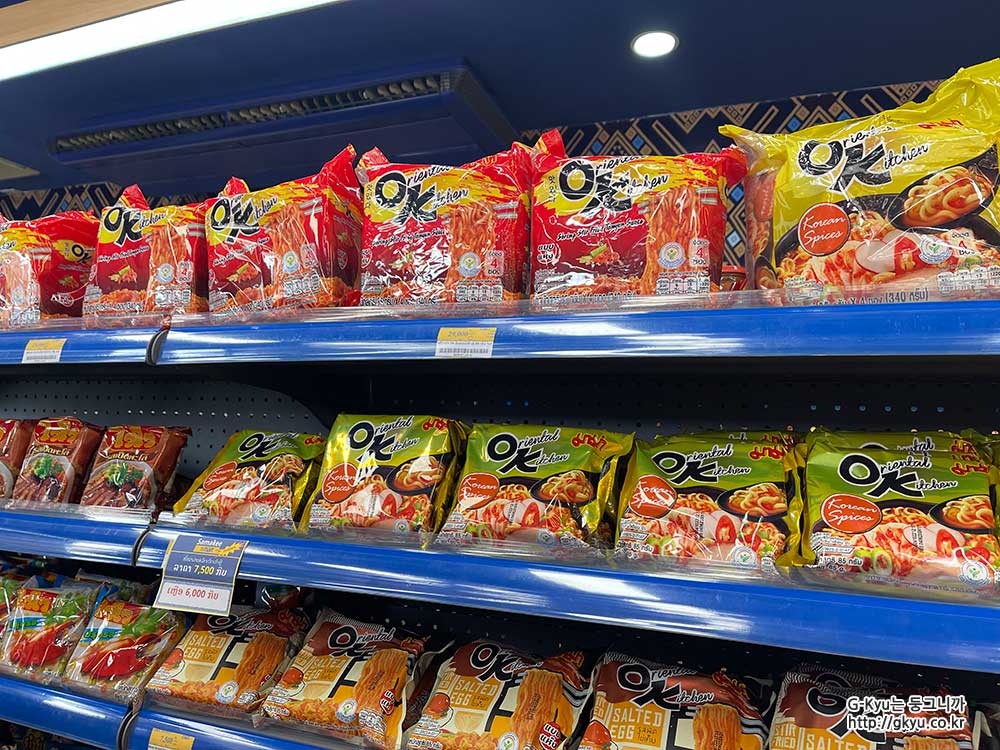
Wandering into the instant noodle aisle, I noticed a large number of Chinese brands. Hilariously, many of these Chinese products were designed to look authentically Korean. Some used bizarre, unnatural Korean fonts rarely seen in actual Korean design, while others featured grammatically awkward Korean sentences.
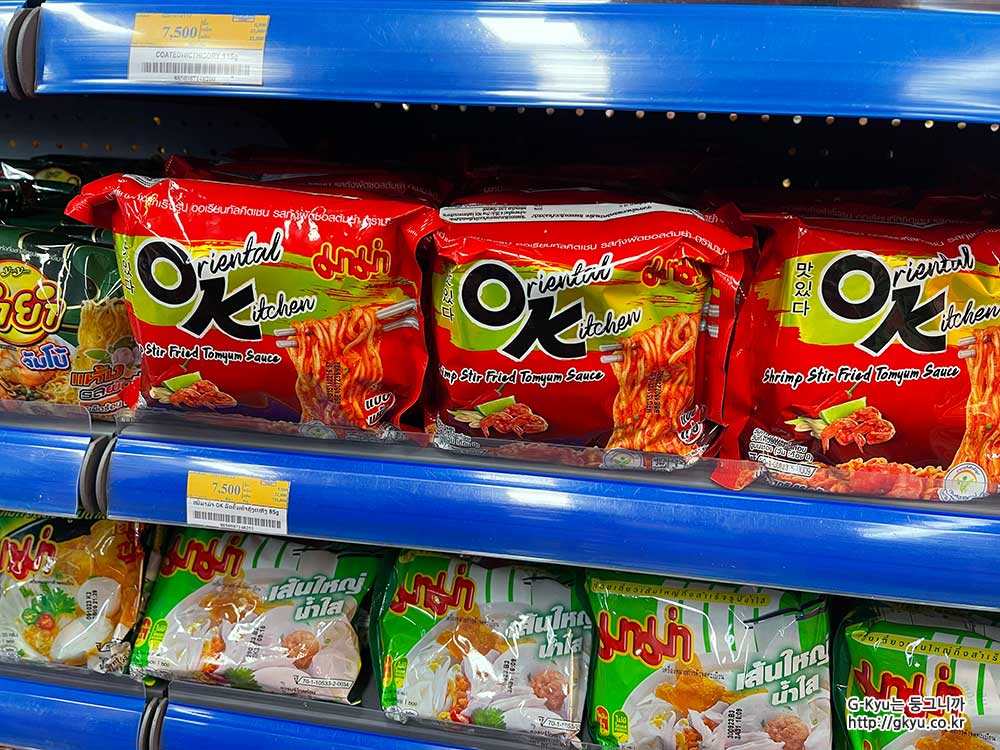
It was a testament to the undeniable Chinese spirit of copying. It’s always baffling to see such mimicry, especially from a country that historically claims cultural superiority.
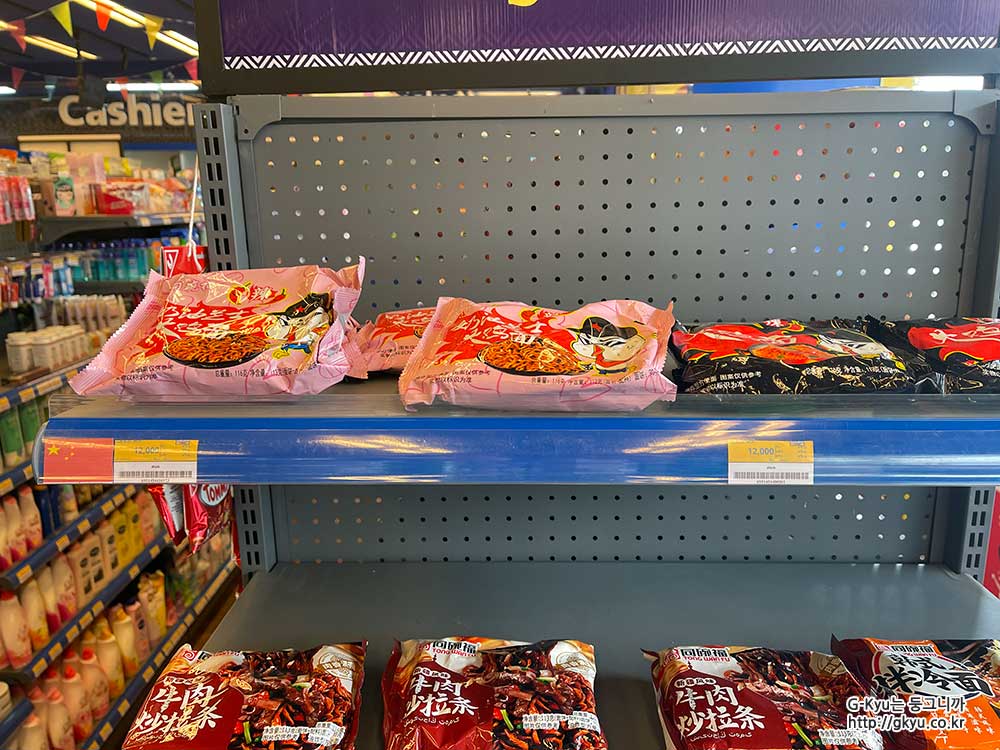
One glaring example was a blatant Chinese knock-off of Korea’s famous Samyang Buldak (Fire) Noodles. The packaging colors and design were identical; the only giveaway was a tiny Chinese flag printed on the price tag. In the world of commerce, however, having your product counterfeited is the ultimate proof of its massive success. Seeing these noodles—which frequently appear in videos by famous Korean travel YouTuber ‘Pani Bottle’—made me wonder just how far this spicy phenomenon has spread across the globe.
“I do not fear the minus 40-degree cold. I do not fear the high cliffs. I do not fear the tropical sun. The only thing I fear is not being able to reach the person waiting for me. If I can make even one more person happy, I do not fear the roughest roads. I am Choco Pie.”
Just like this famous 2011 Korean Choco Pie commercial copy, it seems the Samyang Buldak Noodles are walking a similarly fearless, globe-conquering path.
Decoding the Lao Kip (LAK): A Traveler’s Guide
If you visit Samakee Mart without exchanging money beforehand, there is no need to panic. They accept credit cards, and conveniently, there is a bank right next door where you can exchange US Dollars. The Kip you exchange here will be useful throughout your entire trip, so it’s wise to budget and exchange accordingly.
I had learned prior to my trip that exchanging larger denominations, like $50 or $100 USD bills, yields a better exchange rate due to lower commission fees. Taking this advice, I exchanged a pristine $50 bill and happily paid for my groceries.
For travelers, navigating the exchange rate can be tricky. Based on the rates in May 2023, here are two simple mental formulas to help you calculate prices on the fly:
1. The Quick Korean Won (KRW) Method:
This is the fastest method for Koreans. Simply drop the last zero from the Kip amount and multiply by 0.7.
- Example: For 10,000 Kip, drop the zero to get 1,000. Multiply by 0.7.
- 1,000 * 0.7 = 700 KRW.Depending on the daily rate, it might fluctuate to 0.75 or 0.8, but using 0.7 as a baseline gives you a very solid estimate.
2. The Universal US Dollar (USD) Method:
While a bit slower, this method is perfect when you need to explain prices to foreigners from other countries. Simply divide the Kip amount by 18,000. (Unless you are a math genius, using your phone’s calculator is highly recommended for your mental health).
- Example: 10,000 Kip / 18,000 ≈ $0.55 USD.Once you have the USD amount, you can easily convert it to your home currency. For instance, if the exchange rate is 1,300 KRW to $1 USD: $0.55 * 1,300 = 715 KRW.
- Location: Samakee Mart – Phakhao (ສາມັກຄີມາດ ພະຂາວ)
- Address: 2M82+V83, Av. Kaysone Phomvihane, Vientiane, Laos
A Frappé Break at Black Canyon
After shopping, I needed a moment to catch my breath and ducked into Black Canyon, a Thai coffee franchise located in Vientiane. Like any standard coffee shop, they offered a wide variety of espresso drinks and blended beverages.
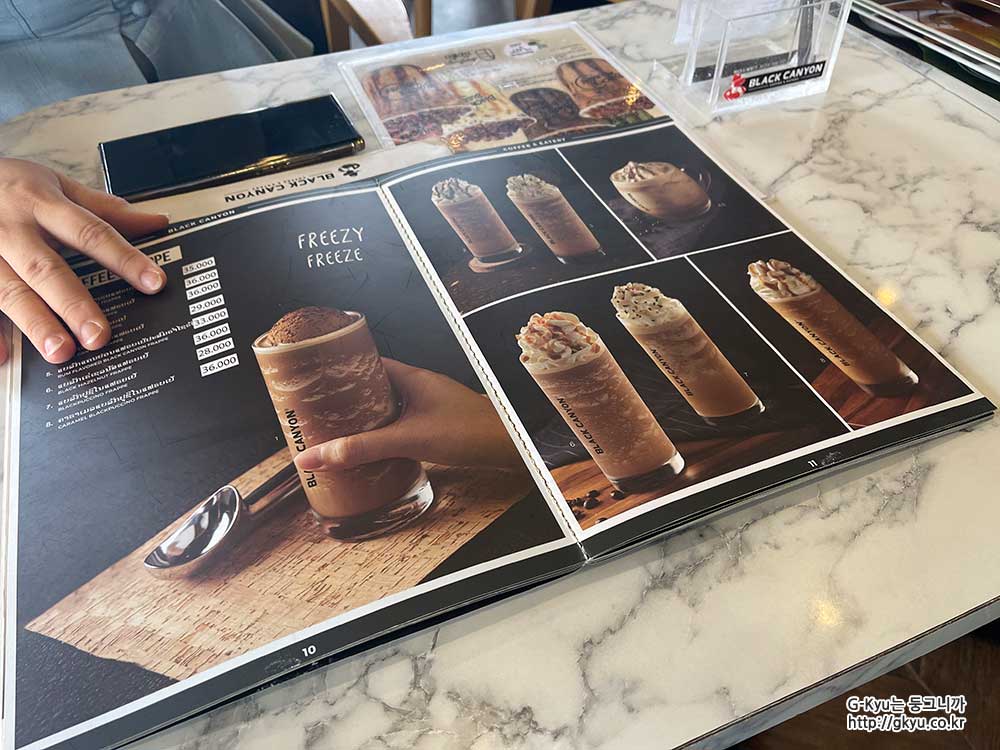
The most expensive item on their menu was a Frappé priced at 36,000 Kip. Applying my first calculation method, this comes out to roughly 2,520 KRW—nearly half the price you would pay at a major coffee chain in South Korea. Since I had already consumed my daily Americano in the morning, I opted for this sweet, icy treat. Interestingly, instead of providing a cardboard sleeve, the café wrapped the plastic cup in a paper napkin, a charmingly practical local touch.
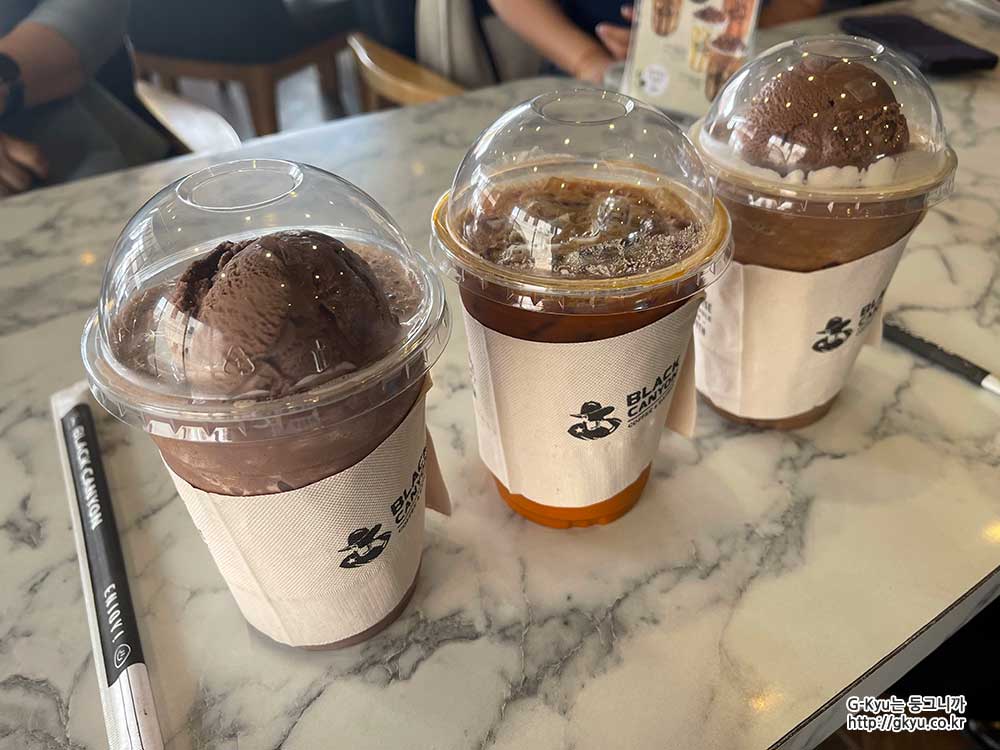
I must admit, I always harbor a slight fear before consuming iced drinks or cold food in Southeast Asia. This apprehension stems from a past trip to Nepal, where I suffered severe stomach issues after drinking the local water. Geographically speaking, outside of Korea and Japan, finding perfectly clean, digestible tap water in Asia is quite rare.
This phenomenon, often referred to in Korea as “water-change” (traveler’s diarrhea), occurs when your digestive system fails to adapt to the different mineral content and bacteria in foreign water. When it hits, your only options are to fast and pray for recovery, or visit a local hospital if the pain becomes unbearable. Experiencing that firsthand in Nepal made me profoundly understand why seasoned travelers always emphasize buying sealed Mineral Water.
Before arriving in Laos, I had sworn off iced beverages to avoid a repeat of the Nepal incident. However, when a host graciously offers you a drink, refusing it feels impolite. So, armed with a silent prayer for safety, I took a sip. Thankfully, my stomach remained perfectly fine. Sweet, ice-cold, and topped with a generous swirl of ice cream, this Frappé was absolute perfection—provided you momentarily forget about the calories.
- Location: Black Canyon Coffee Phakhao
- Address: 2MC2+4HF, 13, Vientiane, Laos
Rimping Supermarket: Shopping with the Elite
To understand the spending power of Vientiane’s affluent class, look no further than the Rimping Supermarket. While Starbucks is ubiquitous in South Korea, there are only two locations in all of Laos—both in Vientiane. Finding one in the Parkson Department Store and the other in the View Mall is a clear indicator that these areas cater strictly to the wealthy elite and expats.
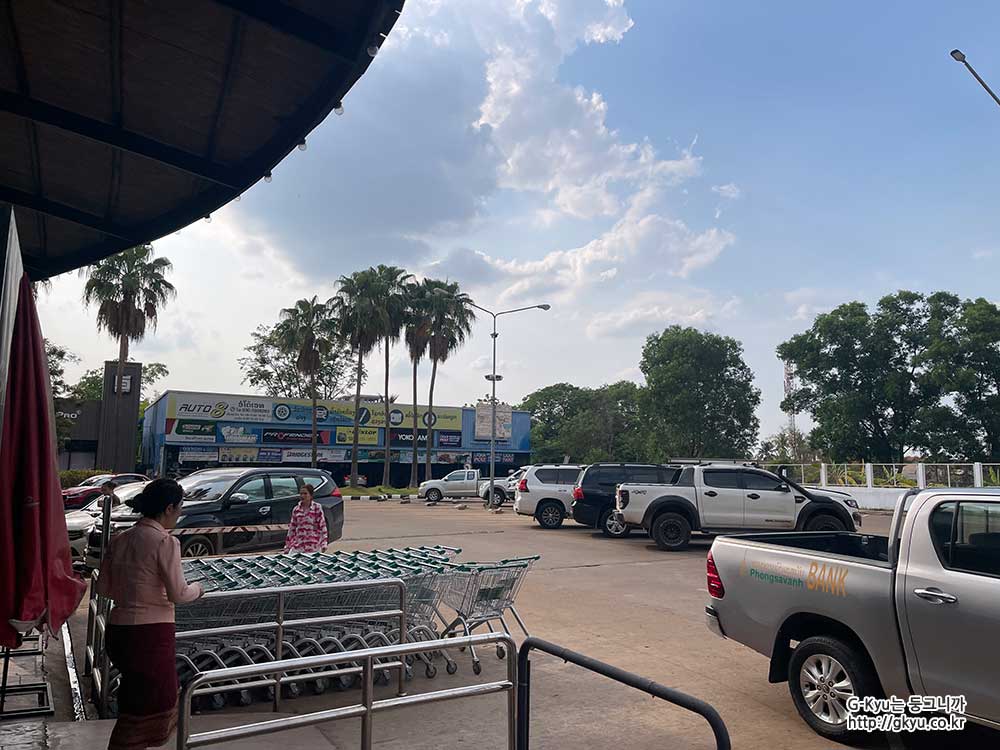
Rimping Supermarket, a Thai premium grocery chain, is located inside this very View Mall. The mall itself is a modest two-story structure, but the grounds are impeccably maintained. Unlike the reverse-parking culture prevalent in Korea, the spacious parking lot is designed for head-in parking.
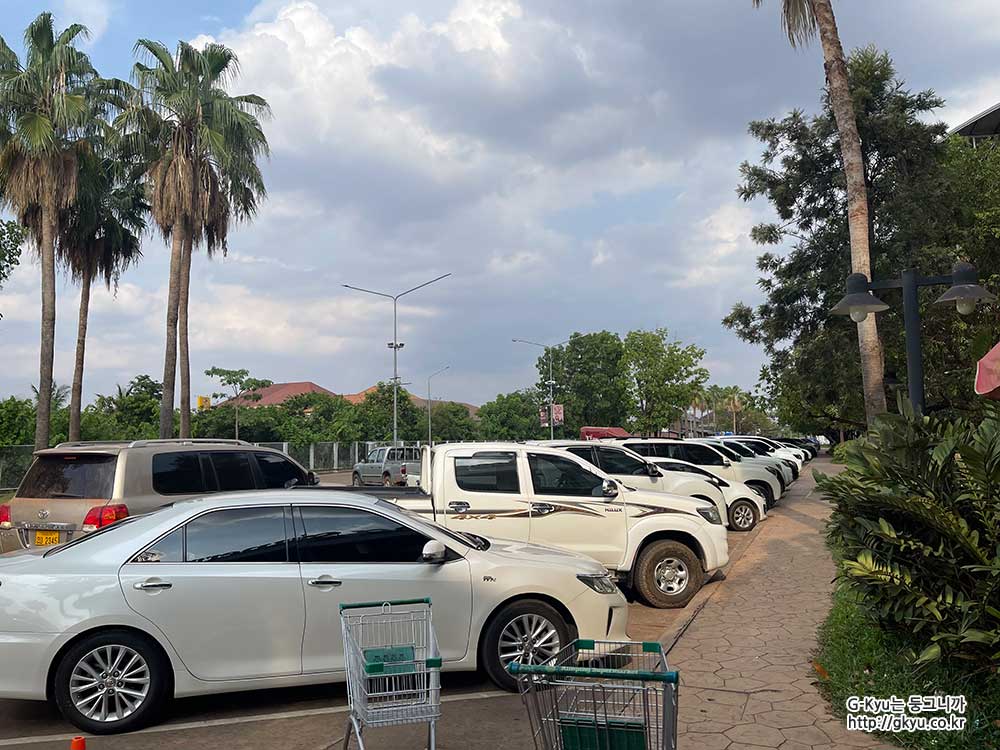
Lined with tall, swaying palm trees, the parking lot alone exudes a distinctly exotic, overseas resort vibe. Inside, Rimping boasts the polished, elegant interior of a high-end department store basement.
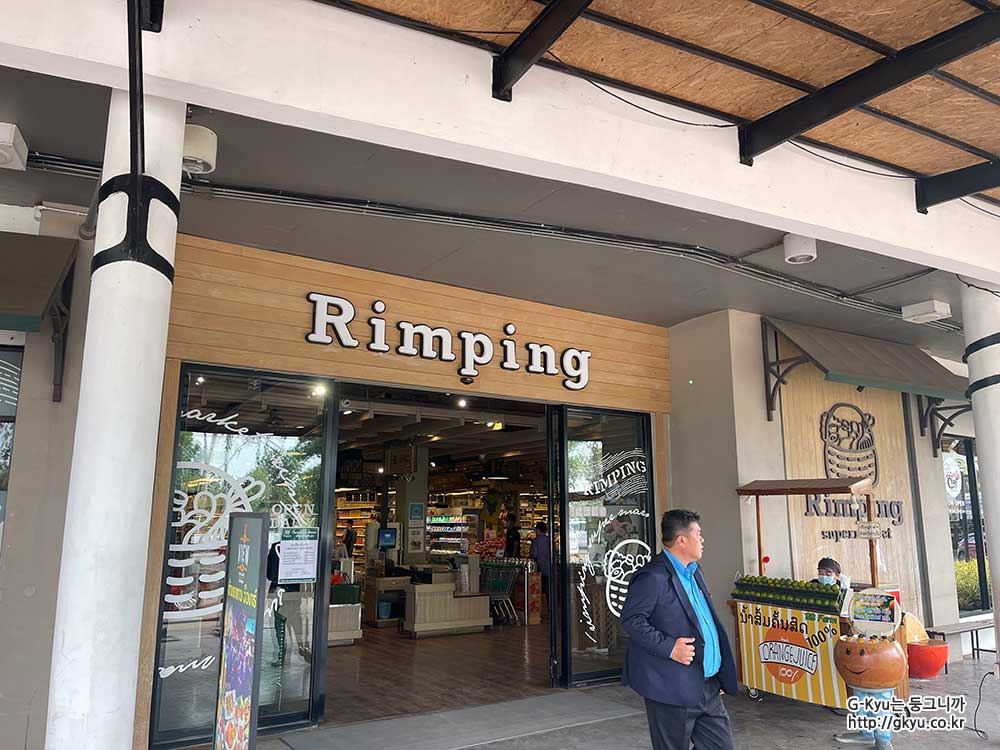
Curious about the cost of living for the wealthy, I investigated the grocery prices:
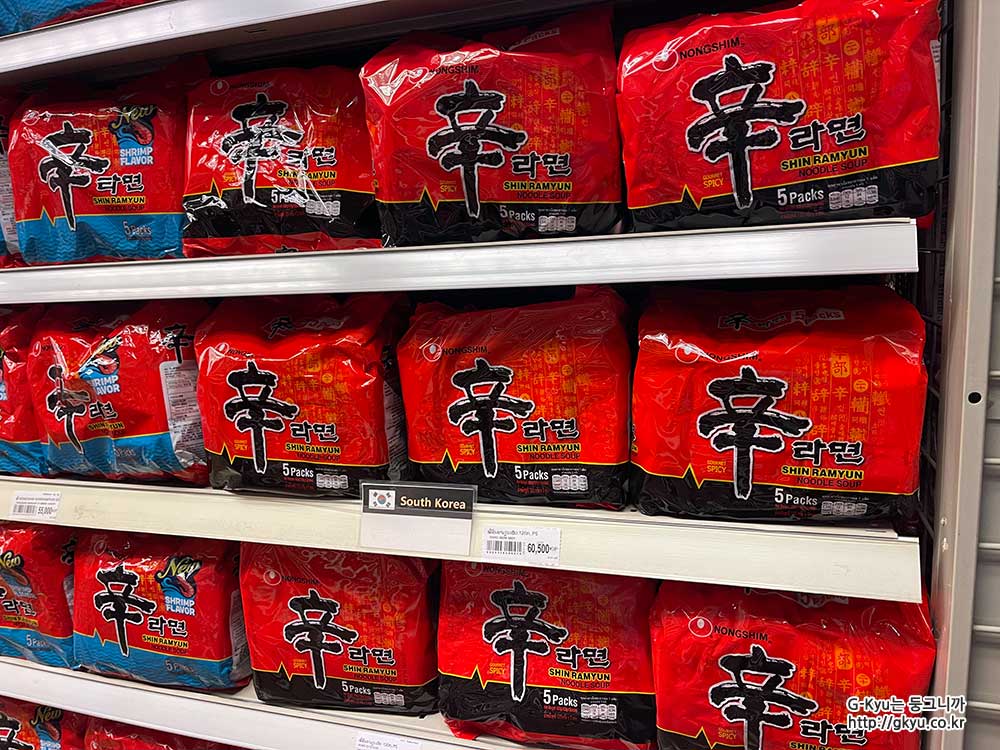
Seeing Korean Shin Ramyun in a foreign land always brings a smile. A 5-pack cost 60,500 Kip (approx. 4,200 to 4,300 KRW), breaking down to about 840 KRW per packet. This is remarkably similar to Korean prices, proving that imported goods in Laos aren’t necessarily cheaper.
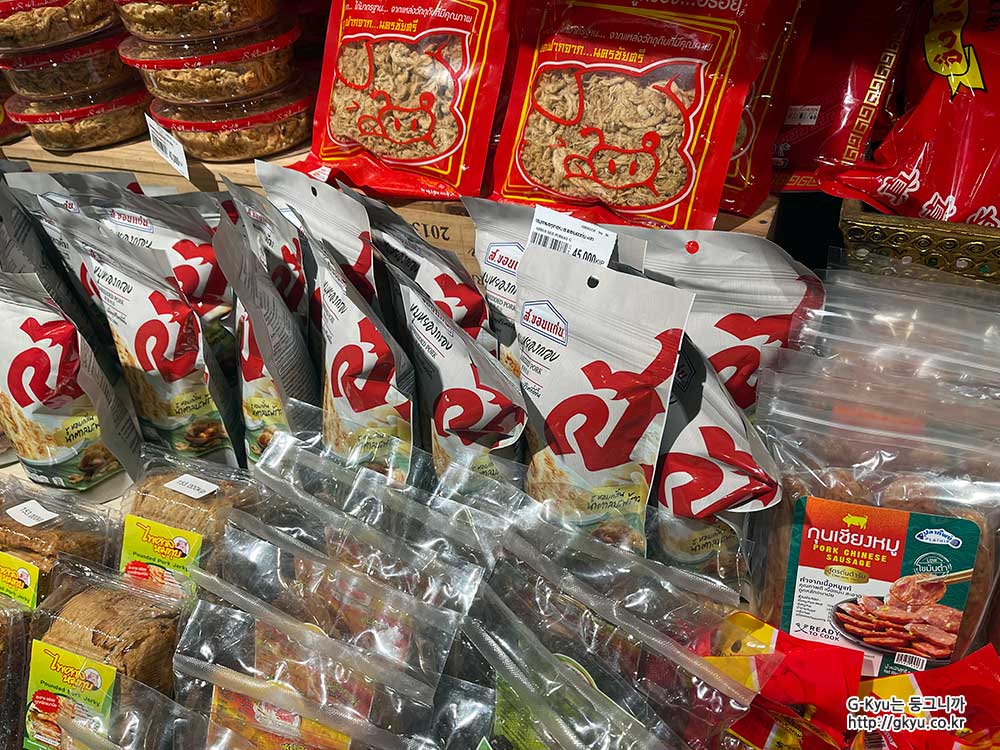
I also spotted shredded dried pork and cheese sausages, with an 8-pack of the latter costing 153,000 Kip (approx. 10,710 KRW).
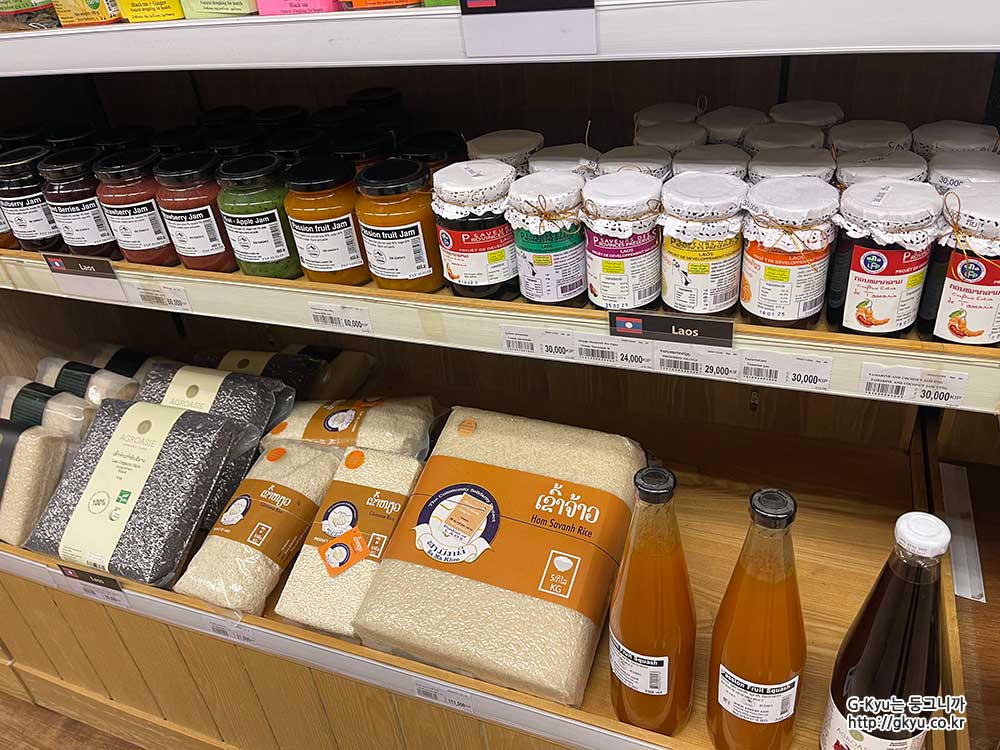
I then compared the prices of the PB products I had seen earlier at Samakee Mart:
- 5kg Rice: Samakee Mart (80,000 Kip / 5,600 KRW) vs. Rimping (115,000 Kip / 8,050 KRW).
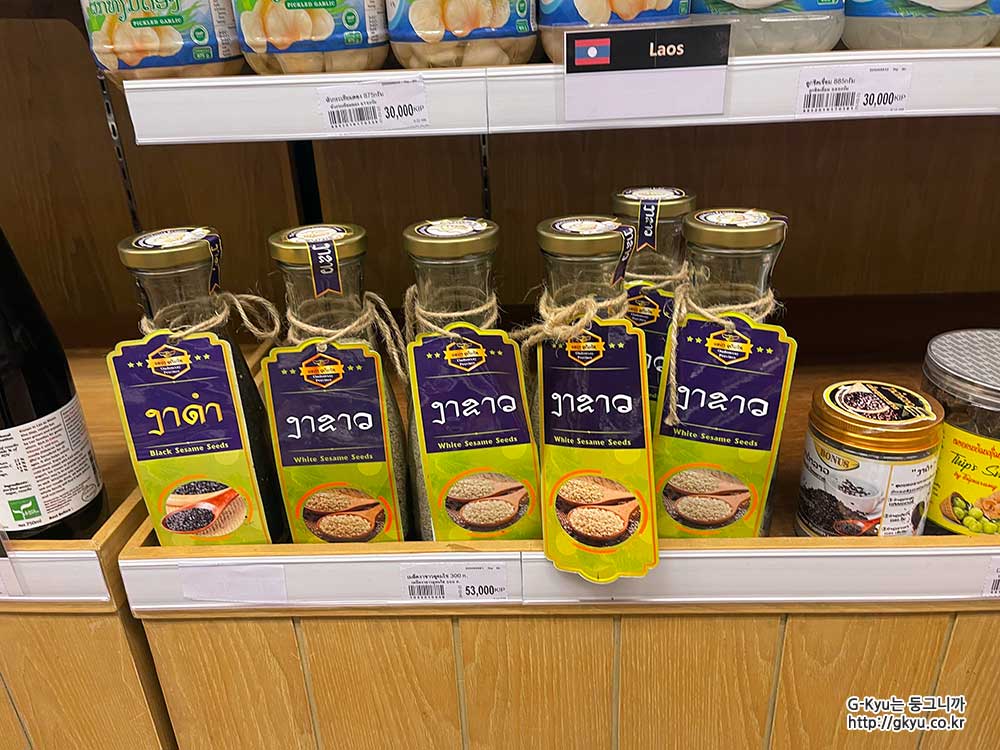
- White Sesame: Samakee Mart (48,000 Kip / 3,360 KRW) vs. Rimping (53,000 Kip / 3,710 KRW).
Moving to the freezer section, I found Japanese treats alongside beloved Korean ice creams like Binggrae’s Melona and Lotte’s Seolleim (both original and Screw Bar flavors).
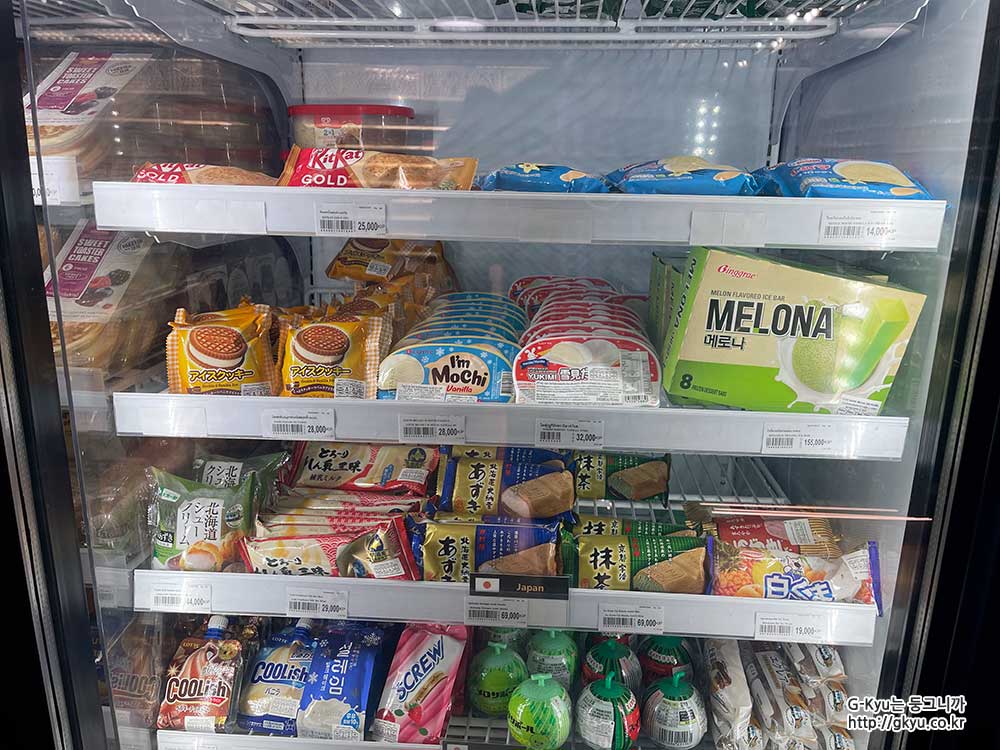
- An 8-pack of Melona was 155,000 Kip (approx. 11,000 KRW, or 1,375 KRW each).
- Original Seolleim was 47,000 Kip (approx. 3,300 KRW).
- Screw Bar flavored Seolleim was 26,000 Kip (approx. 1,820 KRW).Given that this mart targets the upper class, these prices felt quite steep for imported ice cream.
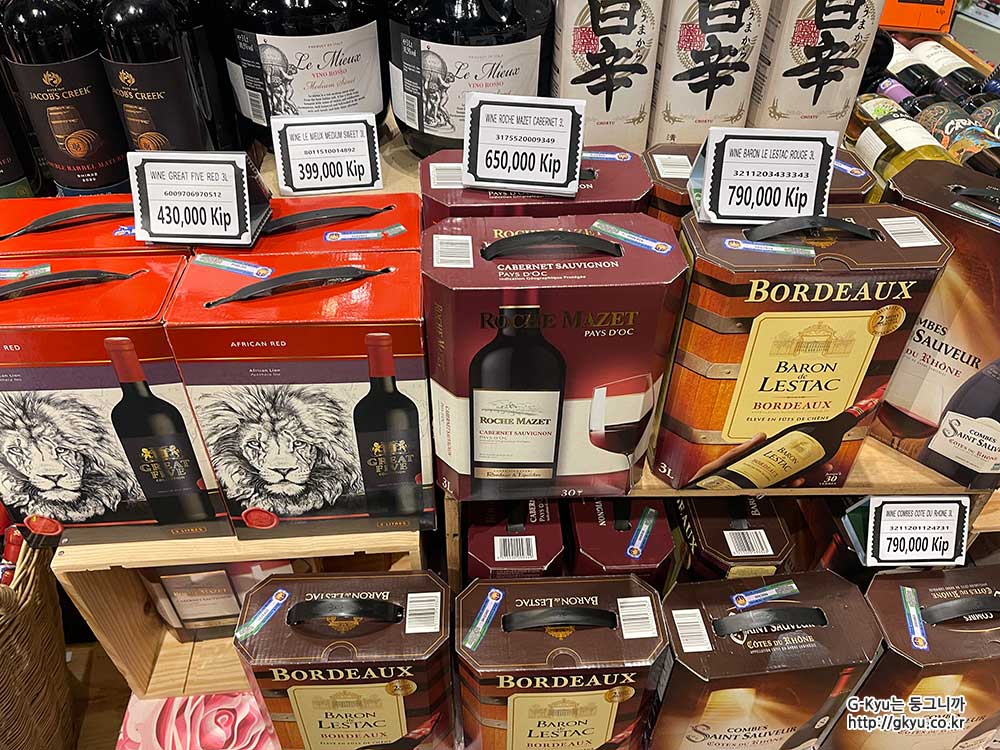
I had read online that alcohol taxes in Laos are high, but locals insisted that wine is actually quite cheap.
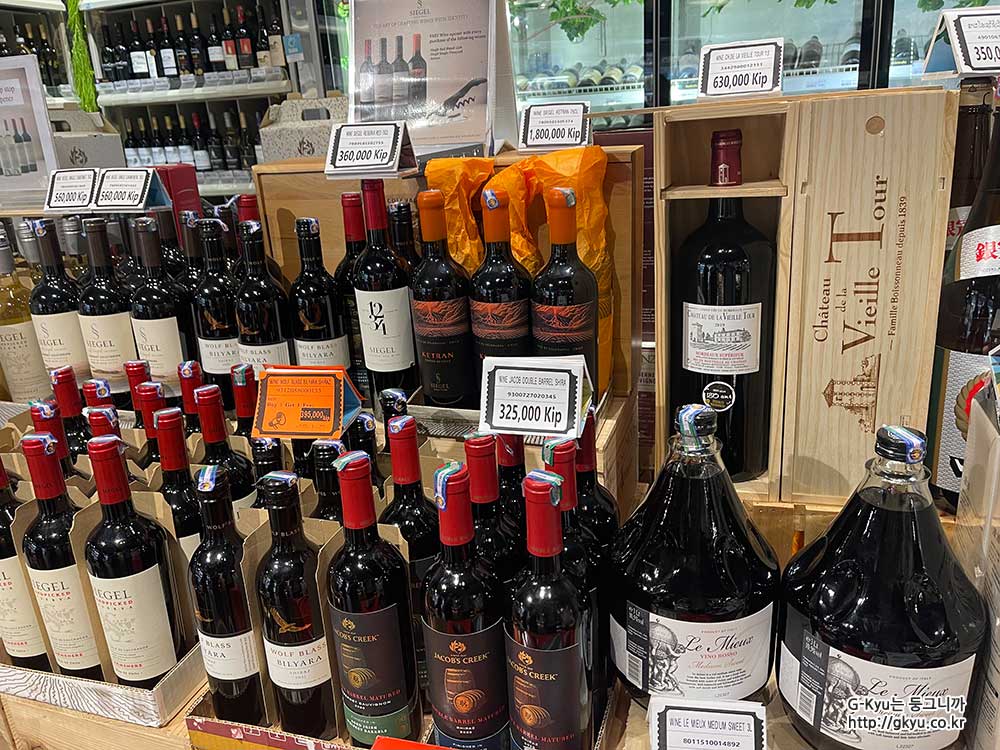
Although I’m no sommelier, I checked the price of a Jacob’s Creek Double Barrel Shiraz: 325,000 Kip (approx. 23,000 KRW).
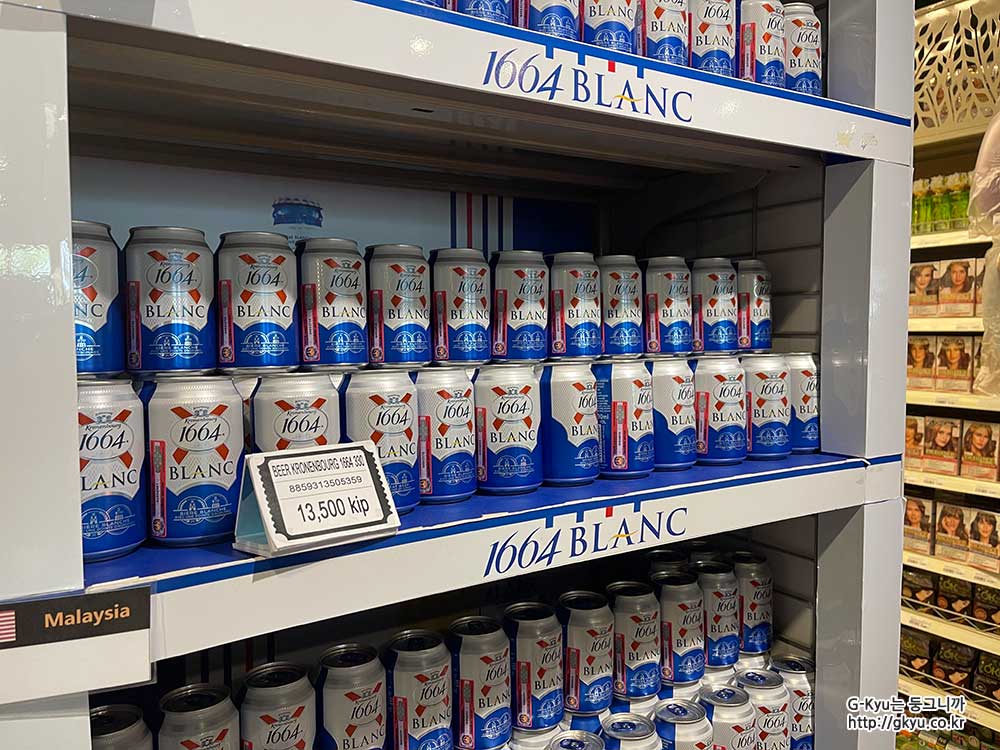
I also found a 330ml can of Kronenbourg 1664 Blanc for 13,500 Kip (approx. 950 KRW). Considering I once bought a 12-pack of this beer on sale at a Korean Costco for 14,790 KRW (1,232.5 KRW per can), the beer in Laos does indeed seem quite affordable.
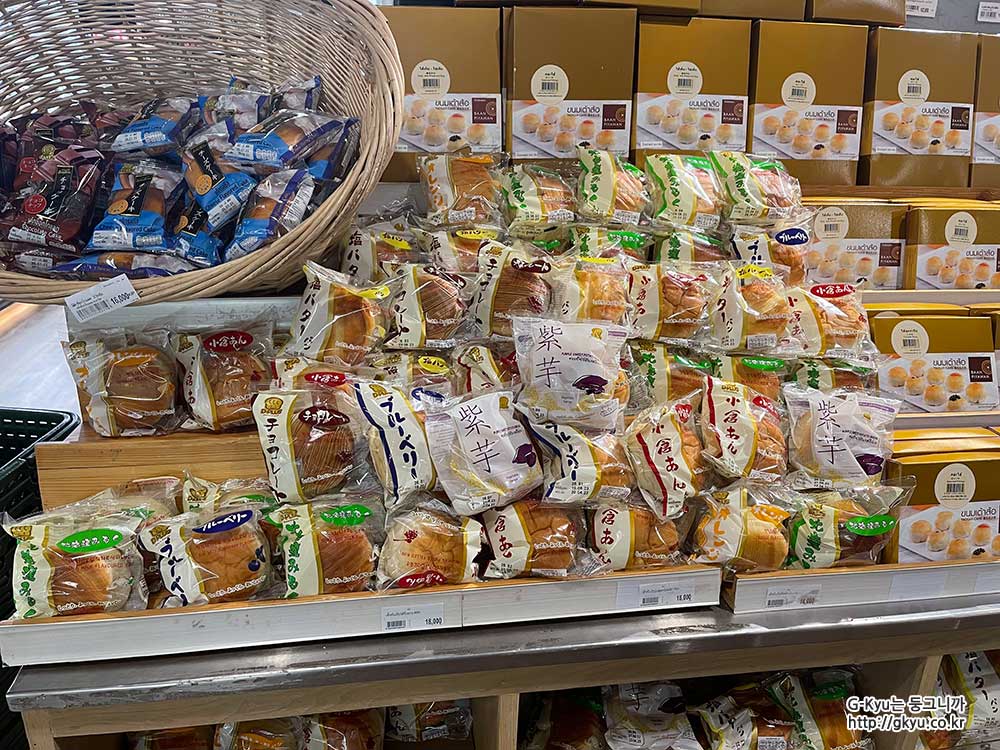
Nearby, the bakery section featured bread wrapped in packaging printed with both Japanese and Lao text, priced at 18,000 Kip (approx. 1,260 KRW) per piece. While Korea is often cited as having the most expensive bread in the world, the prices at Rimping didn’t feel drastically cheaper.
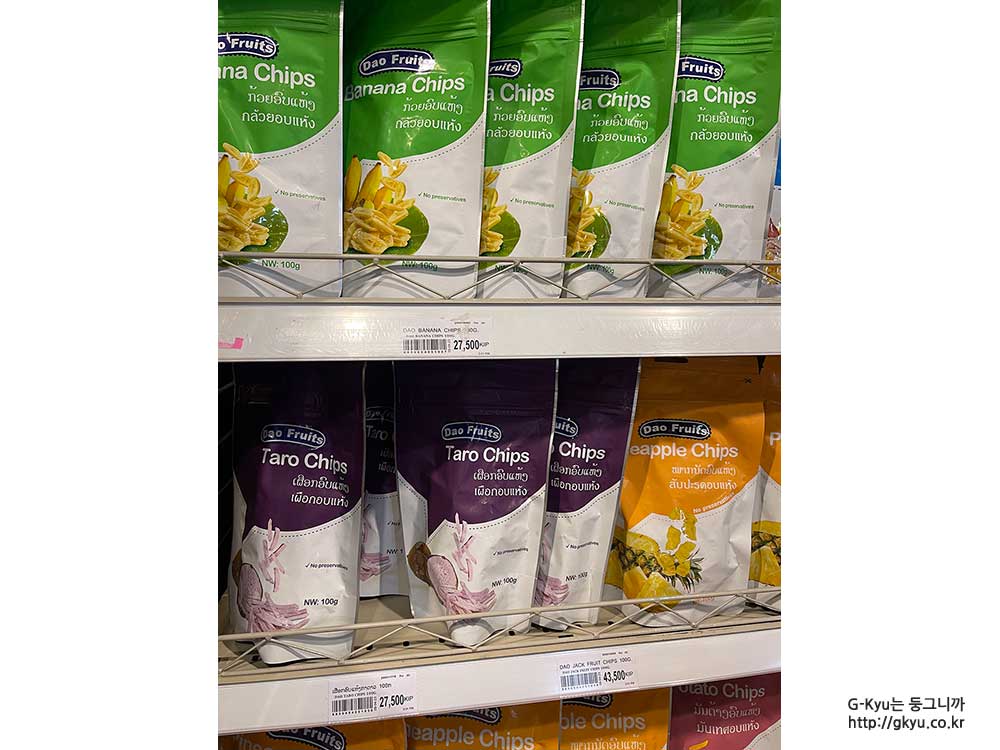
Finding genuinely “Made in Laos” products took some effort, but I eventually found dried fruit chips by the local brand ‘Dao’. Banana and Taro chips (100g) were 27,500 Kip (approx. 1,925 KRW) each, while Jackfruit chips were slightly more at 43,500 Kip (approx. 3,045 KRW). Since I rarely eat dried fruit, I couldn’t judge the value, but they make for excellent, authentic souvenirs.
Leaving the store, I couldn’t quite decide if Rimping was inherently overpriced or simply stocked with premium goods. Even the wealthy don’t spend money recklessly, so the high prices likely reflect the quality of the imported inventory. However, strictly from a price perspective, there wasn’t much merit compared to shopping in Korea.
- Location: Rimping Supermarket Viewmall branch
- Address: 13 South Road Vientiane, 01170, Laos
The Relaxed Rhythm of J Mart
J Mart is another major player in the Thai-backed supermarket scene. While smaller than a massive Korean E-Mart or Costco, it perfectly embodies the vibe of a large, well-stocked neighborhood grocery store. It is a sprawling single-story building complete with its own dedicated parking lot.
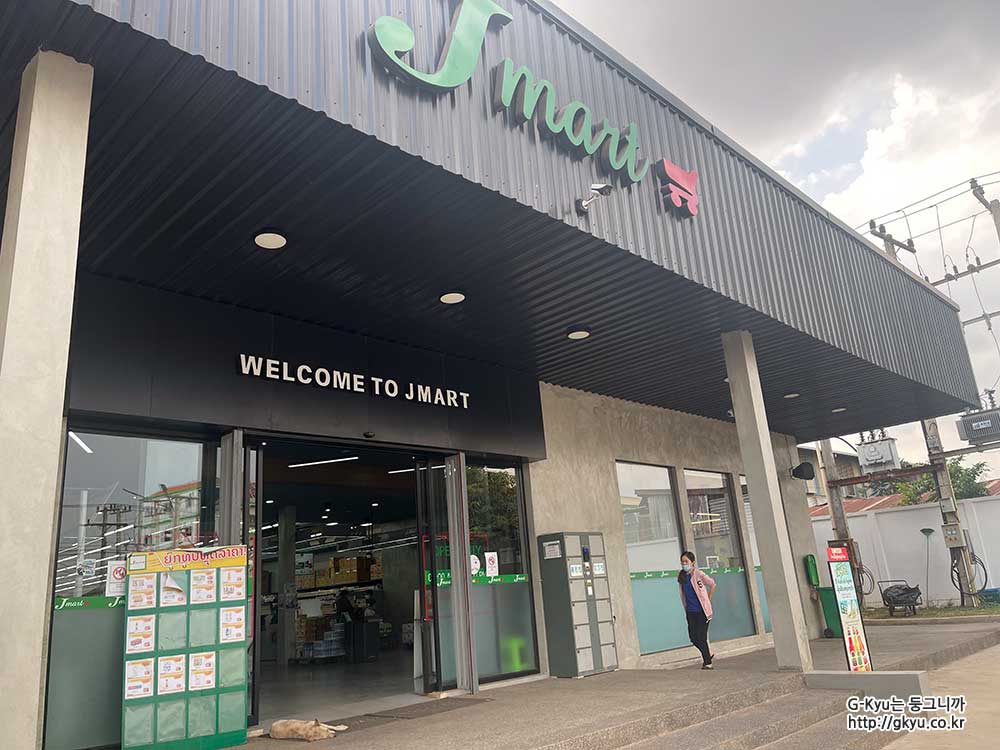
At the entrance, a striking scene unfolded: a dog was fast asleep on the pavement, lying so incredibly still that for a fleeting second, I wondered if it was alive. In South Korea, an unleashed, ownerless dog sleeping in front of a commercial building would immediately prompt complaints, leading to it being chased away or captured by the local district office. But here in Vientiane, it was just another part of everyday life.
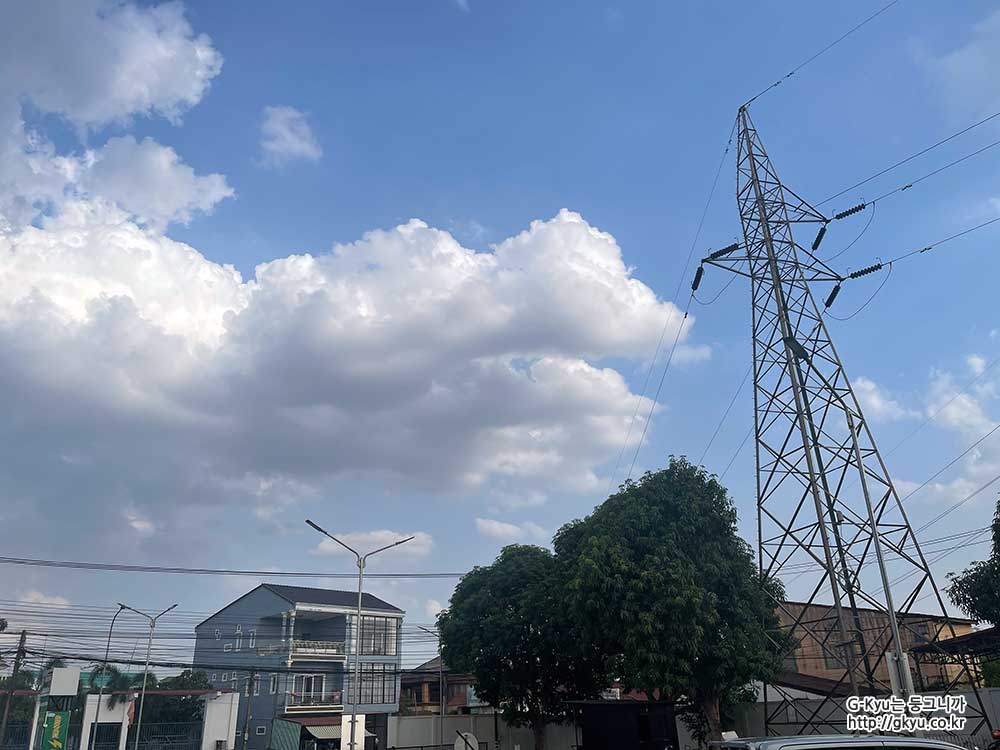
The sun was beginning to set, but the heat remained oppressive. Even humans in shorts and t-shirts were sweating, yet this skinny dog, wearing its natural fur coat, was left completely undisturbed in its slumber. Interestingly, the dog seemed to respect an invisible boundary—it didn’t wander inside the air-conditioned mart but simply lay by the automatic doors, catching the cool drafts that leaked outside.
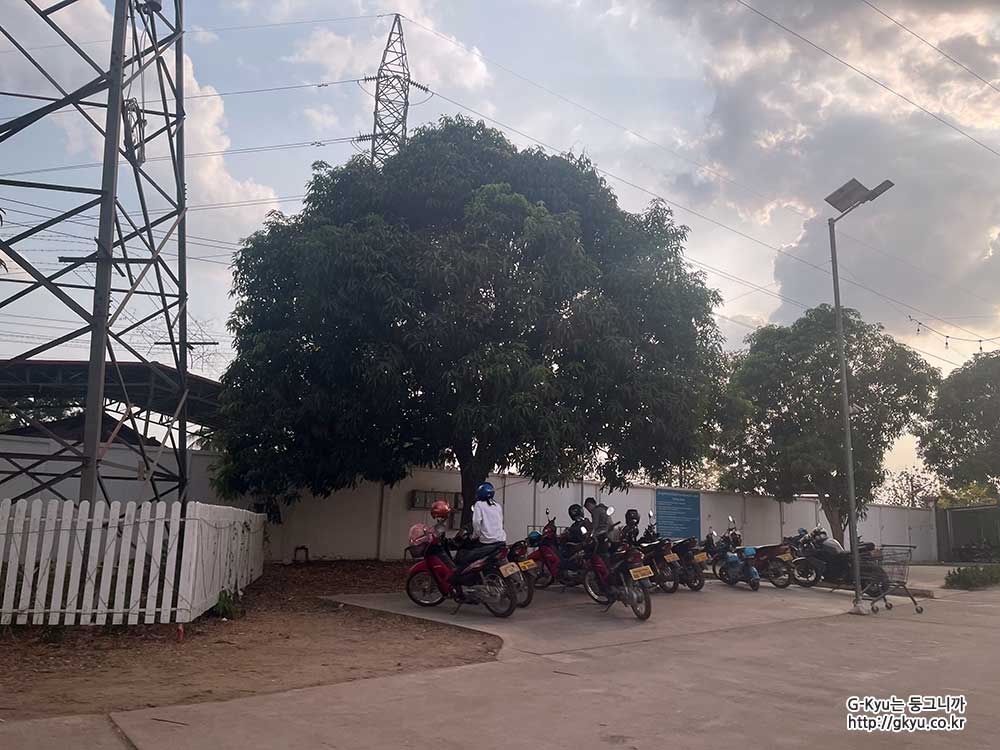
Although it was only May, the sky and the temperature strongly evoked the atmosphere of a late Korean summer transitioning into early autumn. The dedicated motorcycle parking area was neatly organized. Perhaps due to the smaller population, nowhere in Laos ever felt overwhelmingly crowded.
- Location: Jmart-Vangxaiy
- Address: XMM4+VW Vientiane, Laos (Google Maps Plus Code)
The Gentle Art: Levana Massage & SPA
To wash away the accumulated fatigue of the journey, my local guide highly recommended a massage. While I was familiar with Thai massages, the concept of a “Lao massage” was entirely new to me.
The fundamental difference between the two lies in the intensity. Thai massages are famously vigorous, sometimes involving deep, bone-cracking stretches. In stark contrast, Lao massages are characterized by soft, gentle, and rhythmic pressure. For first-timers, this milder approach might be much more suitable. However, if you are a veteran of strong Thai massages, you might find the Lao style so gentle that you wonder if you’re being massaged at all. (Of course, you can always ask your therapist to increase the pressure if needed).
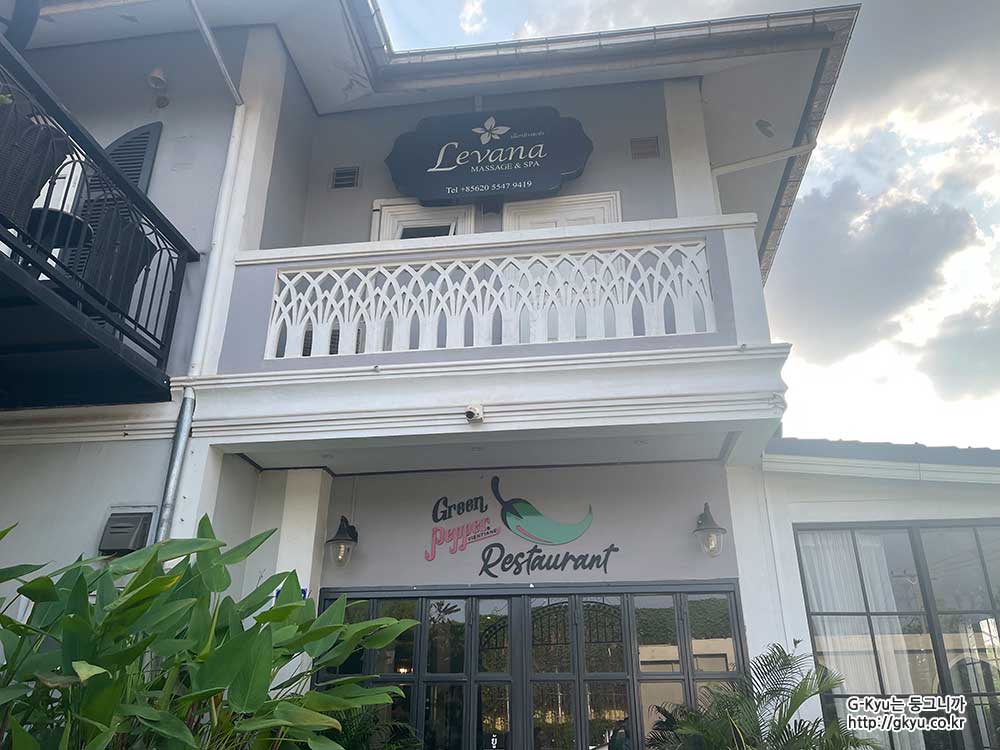
Levana Massage & SPA is conveniently located on the second floor of the same building that houses the Green Pepper Vientiane Restaurant, right across from the elegant four-star Le Thatluang D’or Boutique Hotel. To enter, you climb a charming outdoor spiral staircase, at the base of which the prices are clearly displayed:
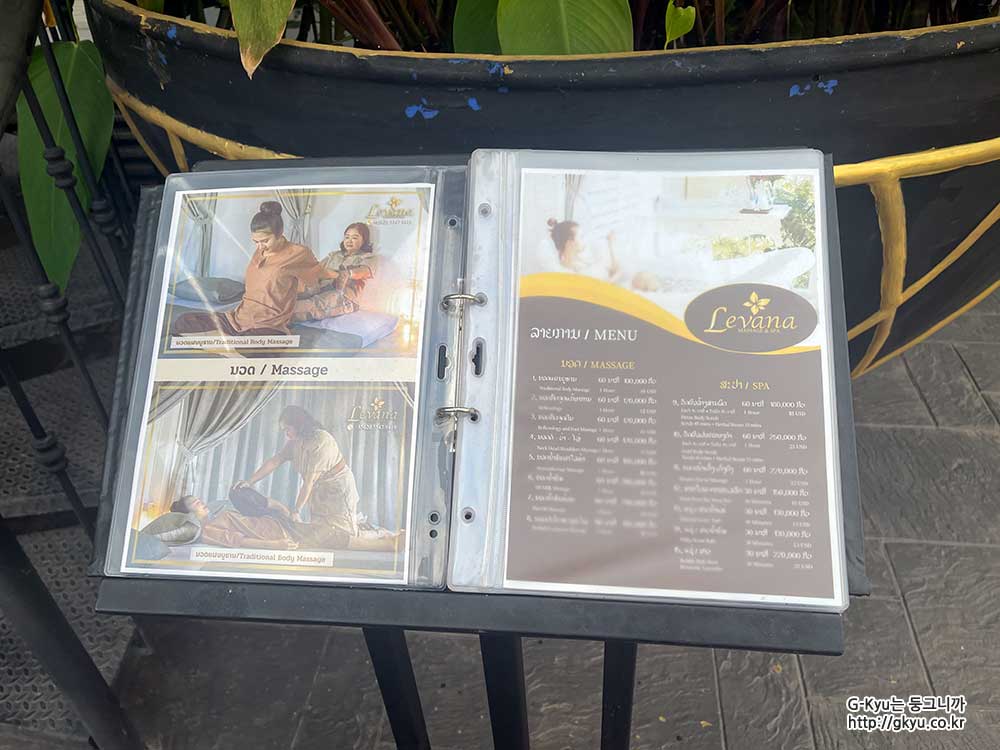
- Traditional Massage (1 Hour): 100,000 Kip / $10 USD
- Foot Massage (1 Hour): 120,000 Kip / $12 USD
The spa seems to use a flat conversion rate of 10,000 Kip to $1 USD for simplicity. However, using my earlier calculation method, 120,000 Kip is actually around $6.6 USD. Therefore, paying in local Kip is significantly cheaper than paying in US Dollars.
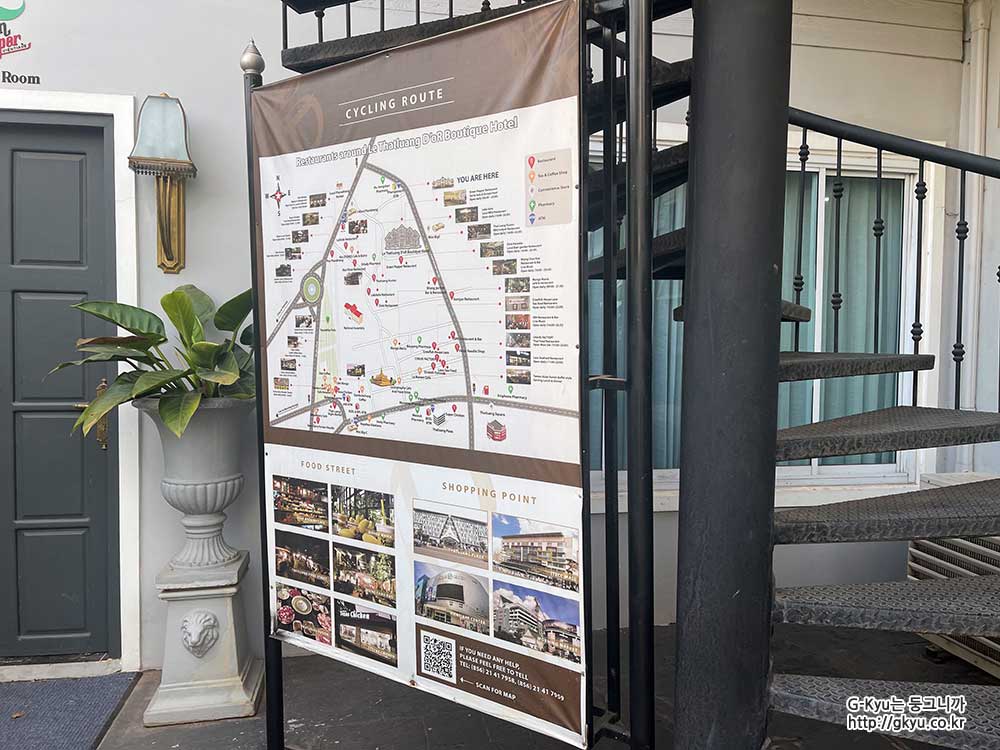
Before heading up the stairs, I noticed a very helpful neighborhood map detailing restaurants, cafes, tourist spots, ATMs, and pharmacies. By scanning the QR code in the bottom right corner with your smartphone, it opens a Google Maps itinerary.
Starting from the current location and passing by the famous Pha That Luang, it maps out a 4.6km route that takes about 59 minutes to walk. Since Vientiane is mostly flat, this makes for an effortless, highly recommended day-trip walking course.
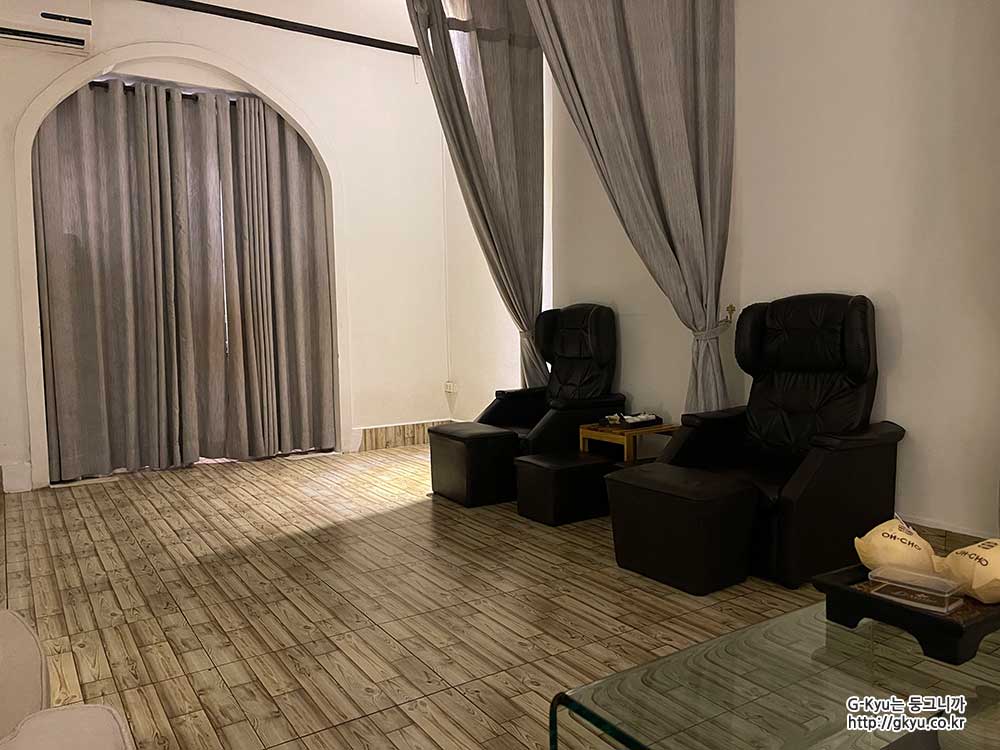
Opening the door on the second floor and leaving my shoes behind, I was enveloped in silence and a mysterious, soothing fragrance. It truly felt like stepping into an unknown, mystical world. While I didn’t see the entire layout, the main area featured comfortable chairs for foot massages, and a hallway to the right led to private rooms with beds for traditional full-body treatments.
I opted for the foot massage. After changing into comfortable trousers, a male therapist (the staff appeared to be exclusively male, matched to the gender of the client) meticulously washed my feet. He then applied a mild, cooling cream—similar to, but less intense than, Mentholatum—and began methodically massaging from the soles of my feet up to my calves. Though advertised as one hour, the session luxuriously stretched to an hour and a half of dedicated care.
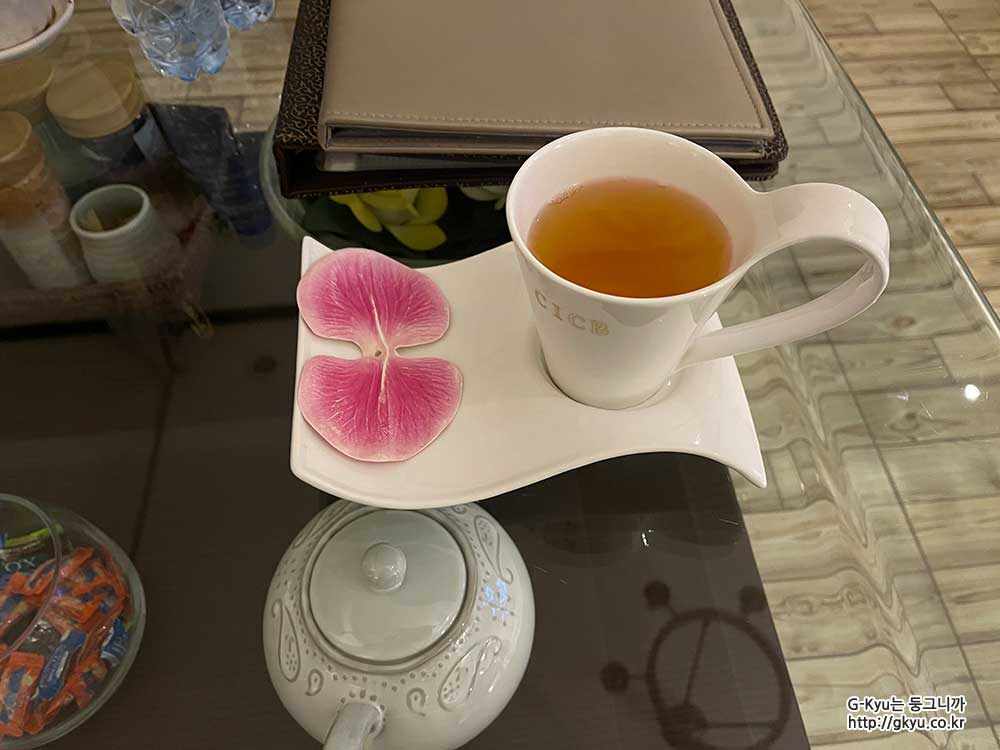
When the massage concluded, I was served a cup of traditional tea. It was served at the perfect temperature—neither too hot nor too cold, just slightly warmer than lukewarm. It felt like a deliberate choice: having just relaxed the outer muscles, the warm tea was meant to soothe and relax the internal organs as well. Because I had specifically requested lighter pressure, the experience felt more like a profoundly comforting rubdown rather than a deep-tissue assault.
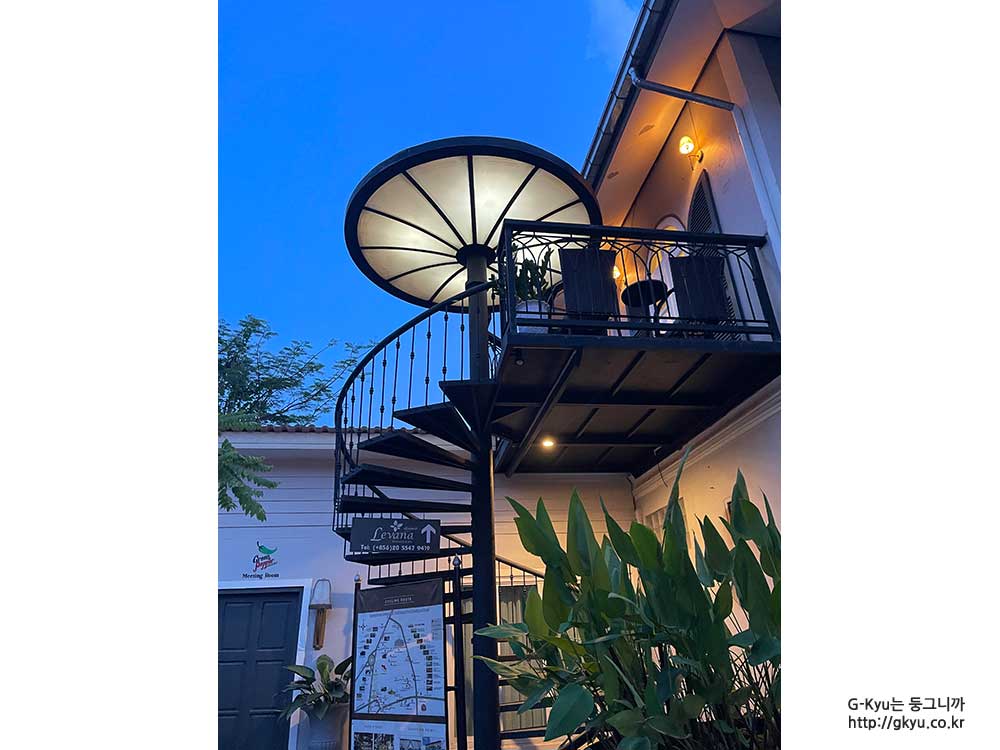
A Golden Hour Farewell
When I finally stepped back outside and descended the spiral staircase, the atmosphere had completely transformed. What felt like bright afternoon when I entered had now surrendered to the encroaching dusk.
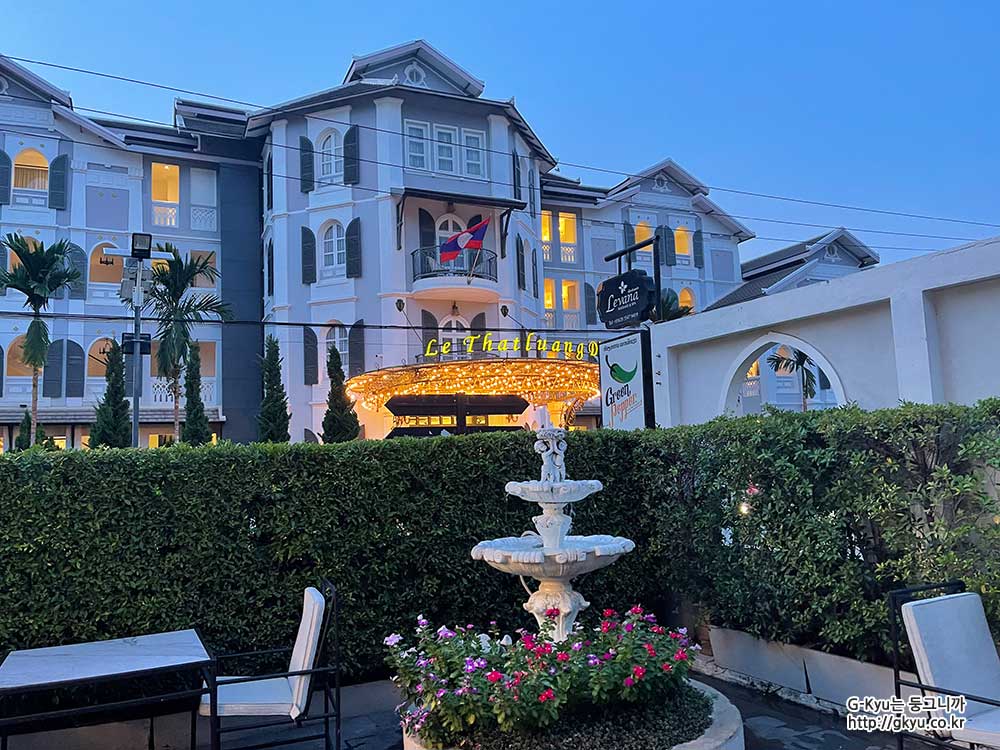
Across the street stood the Le Thatluang D’or Boutique Hotel. Perhaps owing to Laos’s history as a French colony, the building’s architecture—and even the “Le” in its name—exuded a distinct French elegance. While I didn’t stay there, its 4.5-star Google rating suggests it is an excellent accommodation.
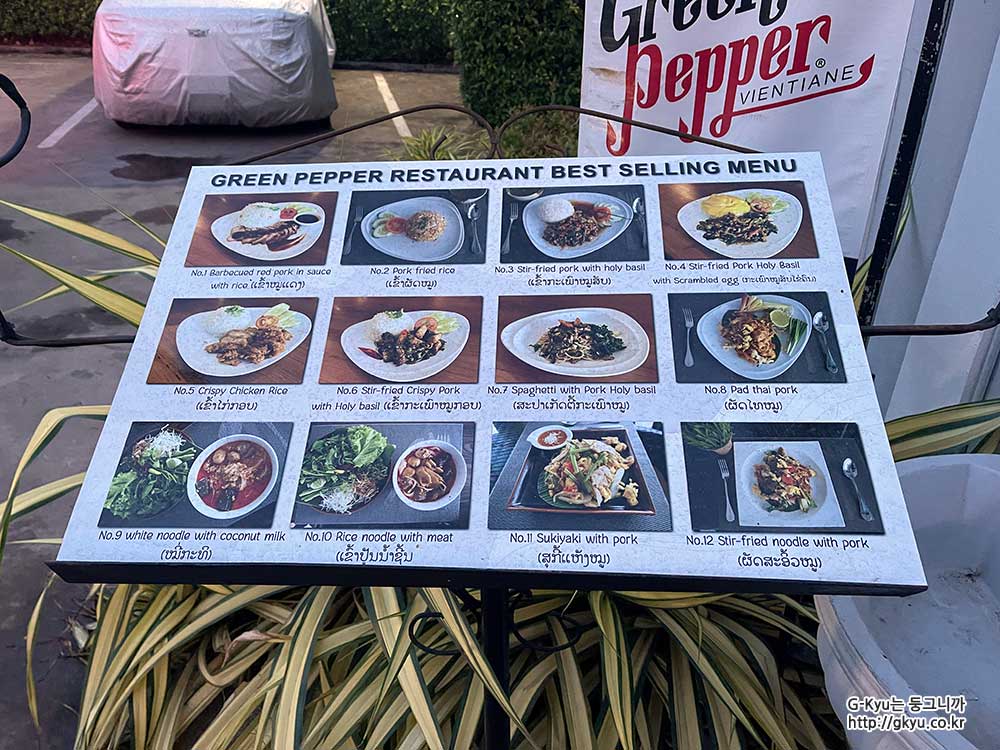
The menu for the Green Pepper Vientiane Restaurant on the ground floor featured predominantly European dishes, though it interestingly lacked price tags.
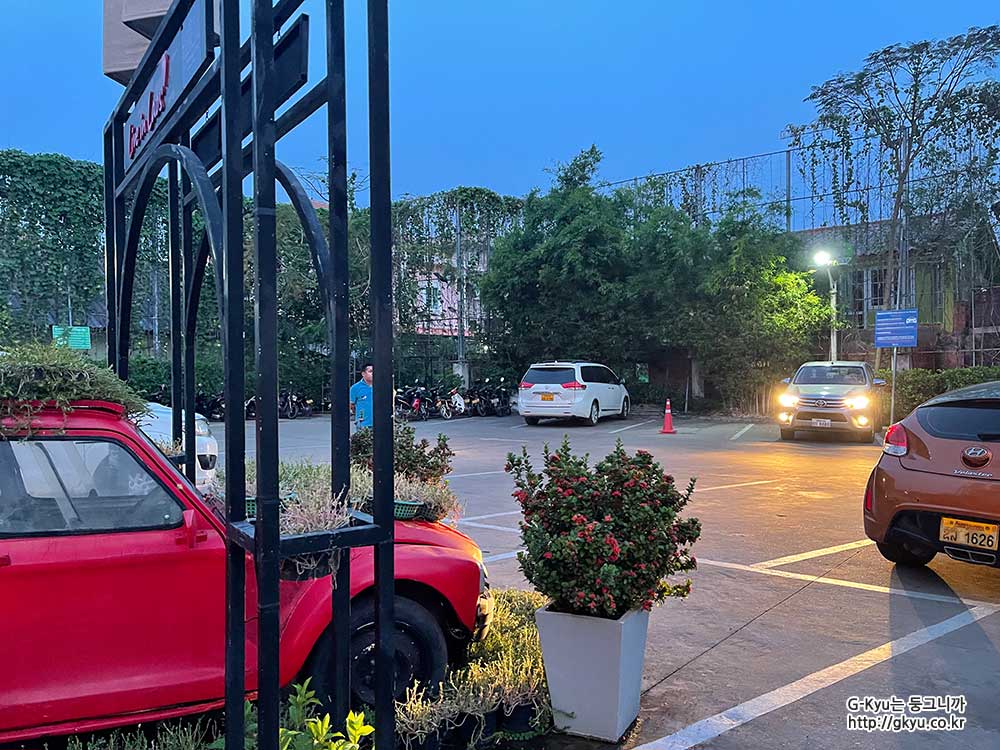
The hotel’s parking lot was surprisingly quiet, and once again, I noticed the local preference for head-in parking.
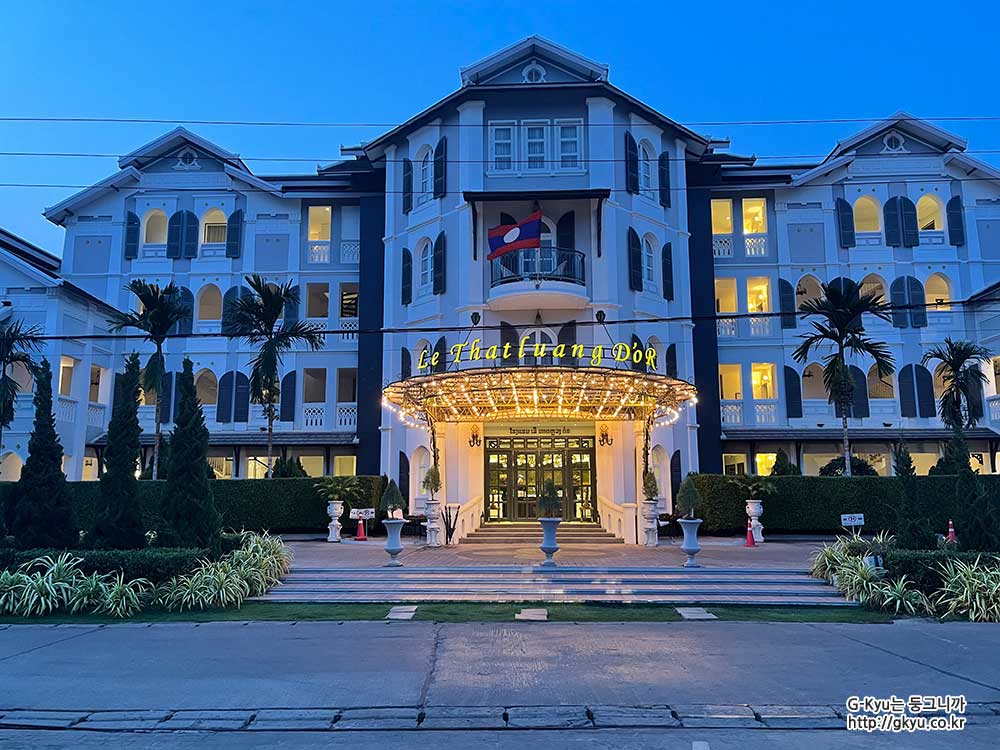
Before leaving, I framed the hotel’s facade in my camera lens. Somehow, the scene looked even more magical in the photograph than it did to the naked eye.
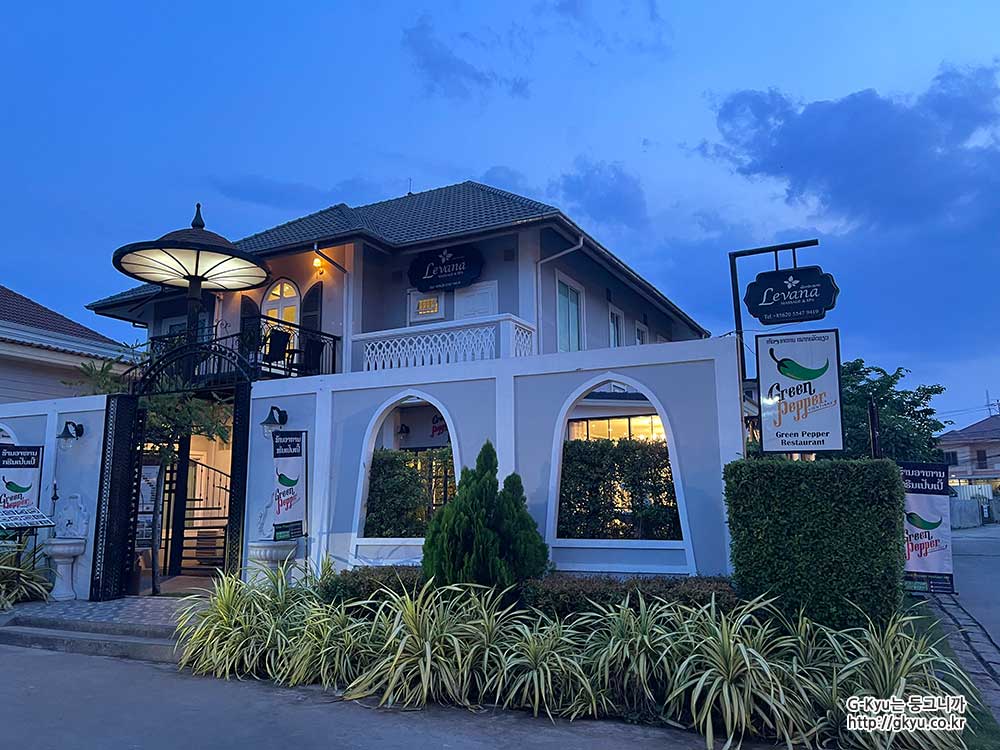
As I pressed the shutter, I had a thought familiar to all travelers: we take photos not just to document, but to permanently preserve the landscapes we might never see again.
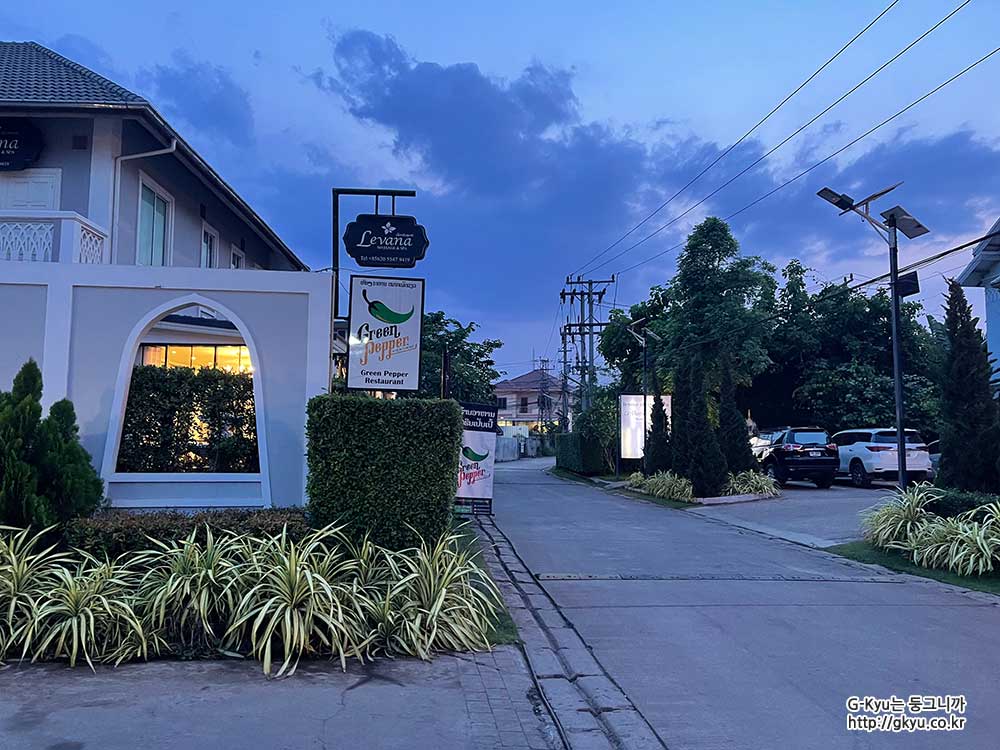
Despite it being dinnertime in a rather beautiful location, there were very few people around, likely because it wasn’t peak tourist season. But for me, this was a blessing. After constantly navigating the crowded, chaotic streets of typical tourist destinations, this quiet, empty road brought a profound sense of peace to my mind.
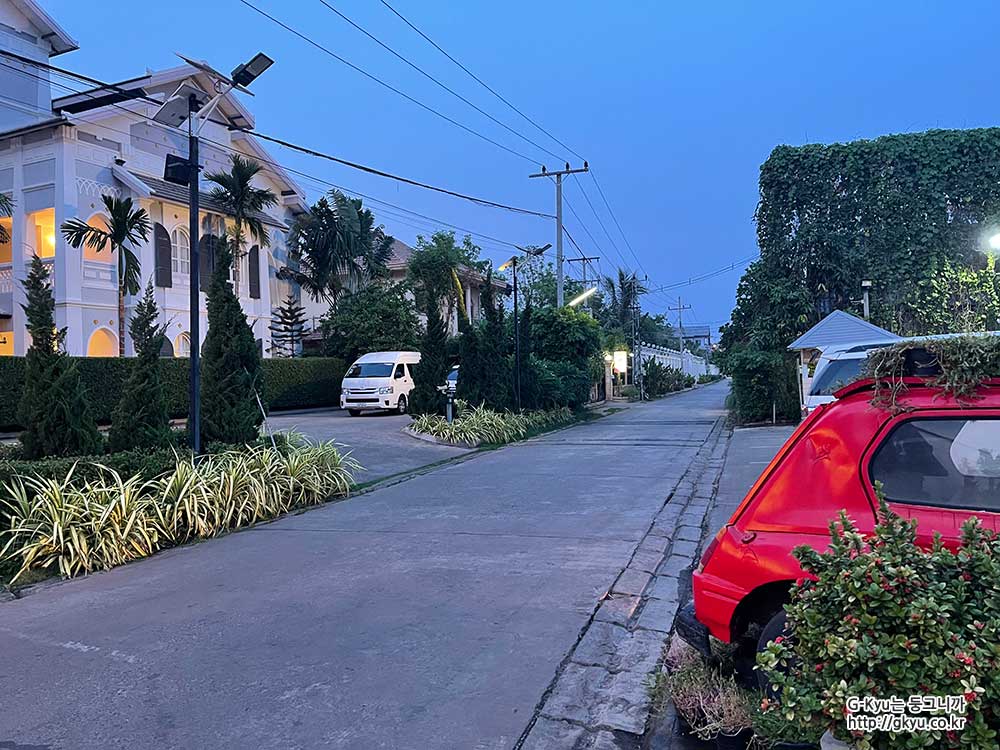
Standing there in the May evening, feeling the distinct vibe of a late Korean summer blending into early autumn, I felt as though I was gracefully slipping through time.
- Location: Levana SPA
- Address: XJJP+VQ Vientiane, Laos (Google Maps Plus Code)